


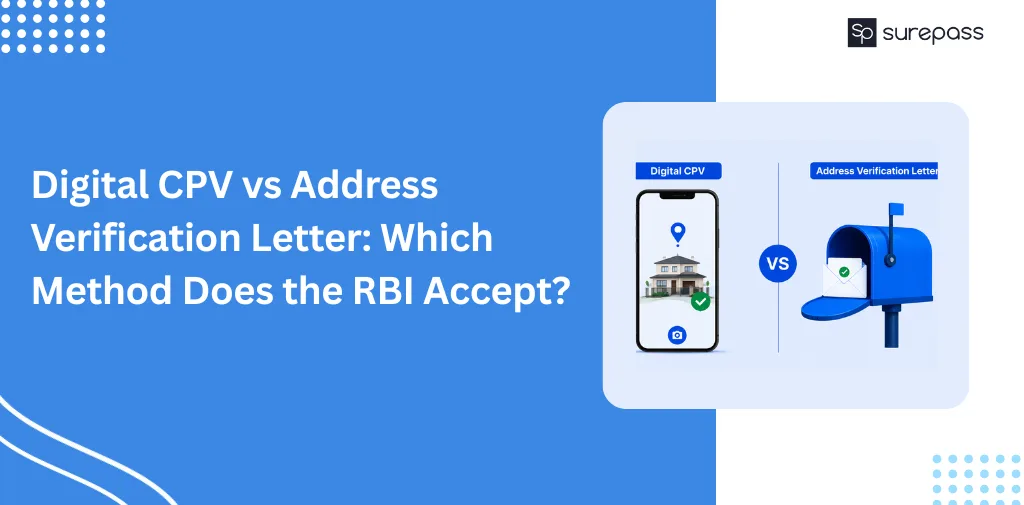
Both the address verification letter and Digital Contact Point Verification (CPV) are valid methods of positive confirmation for a customer’s declared address. RBI does not rank one above the other. Your bank or NBFC picks the method based on its own risk policy.
The Digital CPV vs address verification letter debate comes up in almost every KYC audit. And most teams argue from assumption, not from the rulebook. Some believe RBI insists on a posted letter because “that is how banks always did it.” Others believe a field visit is compulsory for every loan. Both beliefs are wrong.
Here is what the regulation actually says, in simple words.
What Is Contact Point Verification (CPV)?
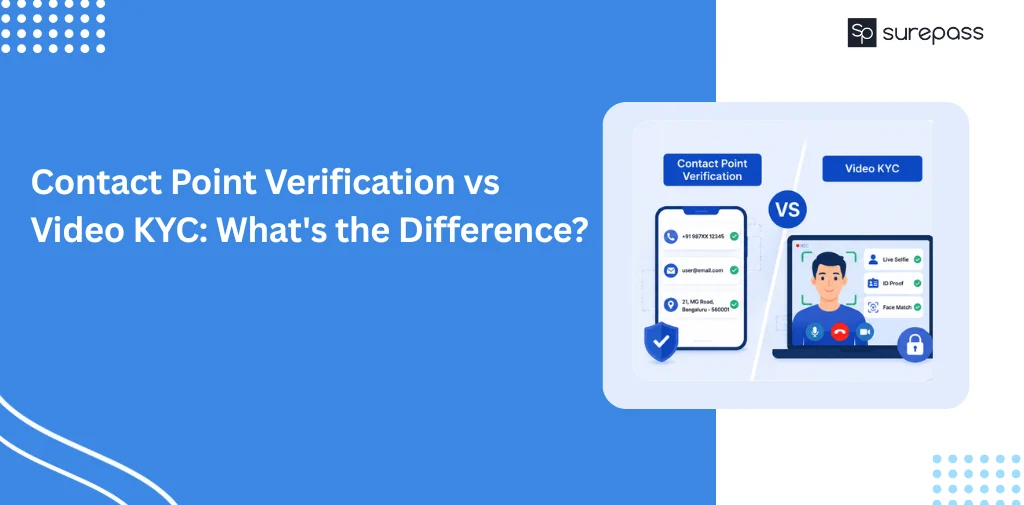
CPV is a check where the lender confirms that the customer actually lives or works at the address given in the application. CPV can be done in two ways: Digital and Physical CPV.
- Physical CPV: A field agent visits the home or office. The agent checks the nameplate, meets the customer or a family member, sometimes asks a neighbour, and clicks a geo-tagged photo as proof.
- Digital CPV: The customer gets a link on their phone. They share their live location, click a photo of their door or building, and answer a few basic questions. The whole thing takes 5 to 10 minutes. No field visit is required. The organization uses the Digital Contact Point Verification API for quick verification.
Banks and NBFCs commonly use CPV for credit cards, personal loans, business loans, and current account opening.
What Is an Address Verification Letter?
It is a letter the bank or lender posts to the address the customer declared. Some letters carry a code that the customer must confirm online or at a branch. If the letter reaches the customer, the address is treated as verified. If it returns undelivered, the check fails.
What Does the RBI KYC Master Direction Actually Say?
The rulebook here is the Master Direction on KYC, dated February 25, 2016, which the RBI keeps amending, most recently in 2025. It applies to banks, NBFCs, and other regulated entities (REs).
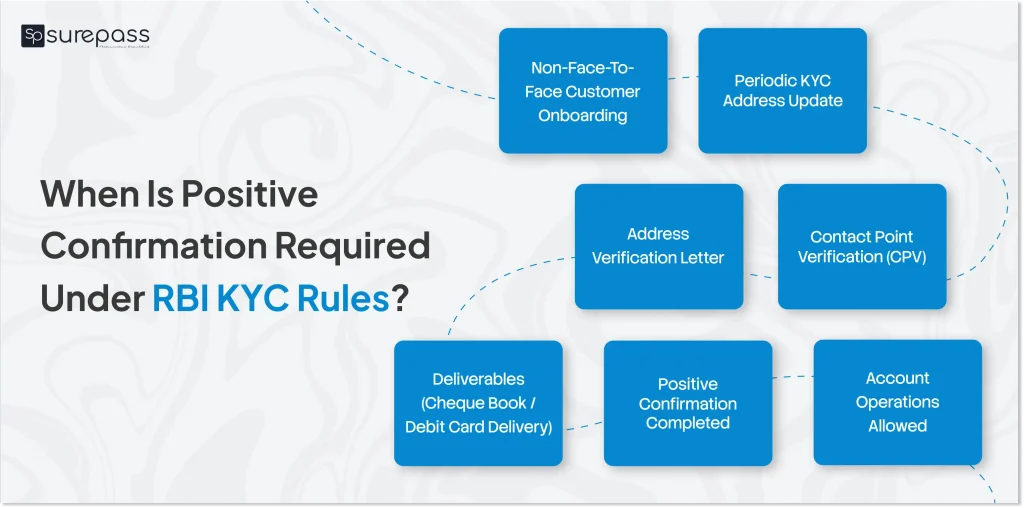
The Direction uses one umbrella term: positive confirmation. It means the RE must actively confirm that the declared address is real, not just file the customer’s word. And the RBI makes this compulsory in two specific situations.
- Non-face-to-face onboarding: If you onboard a customer remotely through digital channels, RBI requires you to verify the current address through positive confirmation before the customer starts operating the account. The Direction lists the acceptable means as an address verification letter, contact point verification, deliverables, and similar methods. Deliverables mean items like a cheque book or debit card successfully delivered to that address.
- Address change during periodic KYC updating: When a customer reports a new address at re-KYC, the RE takes a self-declaration and must verify that address through positive confirmation within two months, again by means such as an address verification letter, contact point verification, or deliverables.
One useful exception: if the customer completes periodic updating through Aadhaar OTP based e-KYC and declares a current address different from the Aadhaar address, no positive confirmation is needed.
Automate your KYC Process & Reduce Fraud!
We have helped 3000+ companies in reducing Fraud by 95%
Why RBI Requires Positive Confirmation?
RBI requires positive confirmation to make sure the customer actually lives or operates from the declared address. This helps reduce identity fraud, fake addresses, and KYC-related risks while keeping customer records accurate.
Which RBI prefers Digital CPV vs Address Verification Letter?
RBI accepts both methods. Banks and NBFCs can choose either CPV or an address verification letter based on their Board-approved KYC policy. During inspections, RBI checks whether the address was verified within the required timeline and whether proper proof is available.
Digital CPV vs Address Verification Letter: Quick Comparison
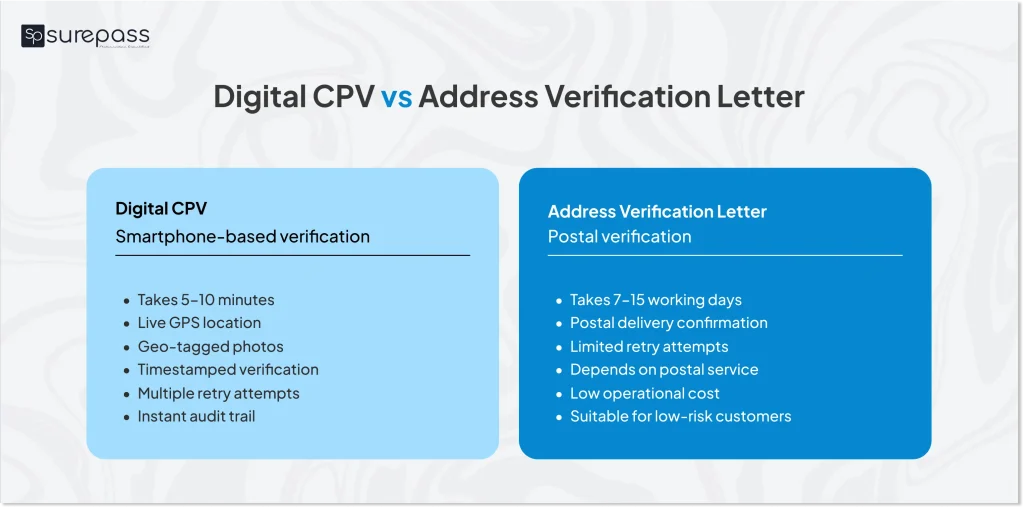
| Point | Digital CPV | Address Verification Letter |
| Time per attempt | 5–10 minutes (digital), 1–3 working days (physical) | 7–15 working days |
| Cost per check | ₹20–₹50 (digital), ₹150–₹400 (physical) | ₹30–₹60 |
| Retries are possible inside RBI’s two-month re-KYC windowProof | Multiple, even the same dayGeo-tagged photo & timestamp | 2–3 at mostPostal delivery confirmation |
Both methods have their own limitations. Digital CPV needs the customer’s participation and a working smartphone, while physical CPV costs more. Address verification letters are cheaper but can be delayed or returned if the address is incomplete or incorrect.
How to Decide Between Digital CPV vs Address Verification Letter?
- Remote onboarding: The account cannot operate until confirmation is done. Digital CPV closes it the same day.
- Re-KYC address change: You have two months. Do not spend half of it waiting on one envelope. Run CPV first, keep the letter as backup.
- Low-risk products with no deadline pressure: A letter is cheap and fully compliant. Use it.
- High-value or doubtful cases: Physical CPV adds a trained human at the doorstep. Worth the cost.
Conclusion
Both Digital CPV and address verification letters are valid ways to meet RBI’s positive confirmation requirement. RBI does not prefer one method over the other. The right choice depends on your institution’s risk policy, customer journey, and turnaround time. For faster onboarding and a stronger audit trail, many lenders prefer digital CPV, while address verification letters remain a compliant option for low-risk cases.
FAQs
Ques: Does the RBI Prefer CPV Over an Address Verification Letter?
Ans: No, the Master Direction lists both as examples of positive confirmation. The choice sits with the bank or NBFC under its own risk policy.
Ques: What Is Positive Confirmation in RBI KYC Rules?
Ans: It is an active check that proves the customer’s declared address is genuine. Accepted means include address verification letters, contact point verification, and deliverables like a cheque book reaching the address.
Ques: When Is Address Verification Compulsory Under RBI Rules?
Ans: Two situations: before account operations begin for customers onboarded remotely, and within two months when a customer declares a new address at periodic KYC updation.
Ques: Does the RBI Accept Digital CPV?
Ans: Yes, CPV is a named method, and the Direction does not restrict how it is performed. A geo-tagged, timestamped digital CPV record actually gives you a stronger audit trail than a delivery slip.
Automate your KYC Process & Reduce Fraud!
We have helped 3000+ companies in reducing Fraud by 95%