


Now every business offers online services, which makes it convenient for the user to access them. However, it has also increased fraud cases, such as unauthorized access and stolen passwords. To prevent this, the business uses OTP verification to give access to genuine users. It prevents the risk of identity theft and keeps the user account safe.
What is OTP Verification?
It is a process of verifying user legitimacy through sending a unique code to the registered phone number or email address. It is a one-time password and temporary code. It is valid for a few seconds or a minute after it expires. It can be used only one time and ensures that the person trying to log in or make a transaction is genuine.
How does OTP Verification Work?
A common verification process includes several steps:
- Step 1: A user signs up/login/payment to the app or any platforms.
- Step 2: The system generates OTP.
- Step 3: OTP is sent via channel (SMS, email app)
- Step 4: User enters OTP.
- Step 5: The system verifies and gives access.
Automate your KYC Process & Reduce Fraud!
We have helped 3000+ companies in reducing Fraud by 95%
Types of OTP Verification
You can classify OTP verification based on generation and how they delivered to the user:
Based on How the OTP is Generated
- Time Synced OTP (TOTP): It is time-bound OTP verification. A new code is generated every few seconds using a secure algorithm. It means even if someone gets access to an old code, it will not work. It is used for verification apps and adds a strong layer of protection against replay attacks.
- Counter-Based OTP (HOTP): This method is not time-bound. It relies on a counter that increases with every request. The OTP remains valid until it is used. It makes it flexible and also requires proper synchronization between systems to avoid mismatches.
Based On How OTP Reach Users
- Text Message (SMS) OTP: A code is sent directly to the user’s mobile number. It is simple and effective for mass adoption. It can be vulnerable to issues such as SIM swapping or network delays.
- Email OTP: The verification code is sent to the email address of the user. It is a secondary option or for less time-sensitive verification.
- App-generated OTP: Instead of receiving code, the user generates it inside an authentication app. It does not depend on external networks. It is faster and reduces the chances of interception.
- Voice Call OTP: Users receive a call where the OTP is read out loud. It is used in low-connectivity areas for users.
- One-Tap/Push Approval: Instead of typing, users simply approve or log in, or complete a transaction through a notification. It enhances user experience and minimizes friction.
OTP vs Other Authentication Methods
| Authentication | Security Level | User Experience | Dependency | Key Limitations |
| OTP (One Time Password) | Medium | Easy | Mobile/Email Network | Vulnerable to phishing and SIM Swap |
| Password | Low | Easy | Memory | Can be guessed or reused |
| Biometrics (Fingerprints/Face ID) | High | Very Easy | Device Hardware | Privacy concerns, device dependency |
| Authenticator Apps | High | Medium | Mobile App | Requires Setup and device access |
| Passkeys | Very High | Seamless | Device+Ecosystem | Limited Adoption |
Why OTP Verification is Important for Business?
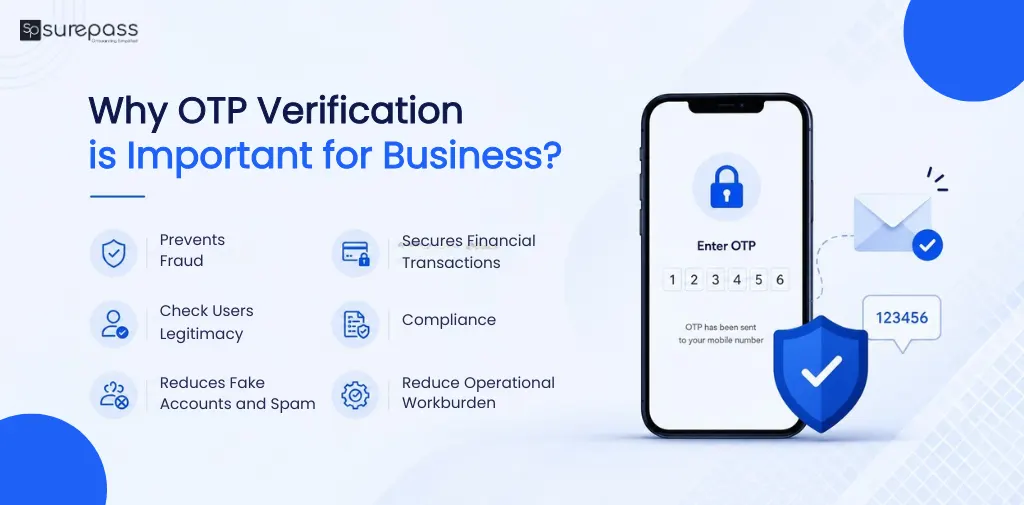
Verification is essential for the following reasons:
- Prevents Fraud: OTP verification adds an extra layer of protection better than passwords. OTP is time-bound; it expires in seconds. It reduces the risk of unauthorized access, phishing attacks, and identity theft.
- Check Users Legitimacy: It helps verify users’ mobile numbers or email addresses in real time. Businesses can confirm that the person interacting with their platform is genuine.
- Reduces Fake Accounts and Spam: It eliminates fake registrations and bot activities. It ensures that the database consists of real users and enhances the quality of leads and engagement.
- Secures Financial Transactions: OTP is used as a factor of authentication. It prevents unauthorized transactions and protects both customers and businesses from financial loss.
- Compliance: Banking, Fintech, and telecom industries require strong authentication measures. OTP based verification helps businesses comply with KYC and data protection regulations.
- Reduce Operational Workburden: It automates the identity verification process and reduces manual checks, human errors, and operational inefficiencies.
Limitations of OTP Verification
OTP based verification enhances security; businesses should be aware of limitations:
- SIM Swap Attacks: SIM Swap frauds are rising, fraudsters are using a mobile number to activate a new SIM Card and gain access to OTPs.
- Phishing Attacks: Sometimes, users are tricked into sharing OTPs on fake websites, emails, or calls.
- Man-in-the-Middle Attacks: If the network is insecure, attackers can intercept OTPs during transmission.
- Device or Channel Compromise: If a user’s phone or email account is compromised, attackers can easily access OTPs.
What are the best practices for secure OTP Implementation?
- Short Expiry Time (30 to 60 Seconds): Choose numeric codes instead of complex codes for SMS and email. It is easier to read and type on mobile keyboards.
- Limit Retry Attempts: It restricts the number of incorrect attempts to prevent brute force attacks.
- Rate Limiting and Throttling: It controls OTP requests per user/device to avoid abuse and spam.
- Multi-Channel Fall Back: It uses a backup channel like SMS and email for timely delivery.
- Device/IP Monitoring: It helps track suspicious login patterns and block unusual activity.
- Avoid Predictable Patterns: Try to generate random OTP that are not easy to trace or identify patterns.
How to Implement OTP Verification?
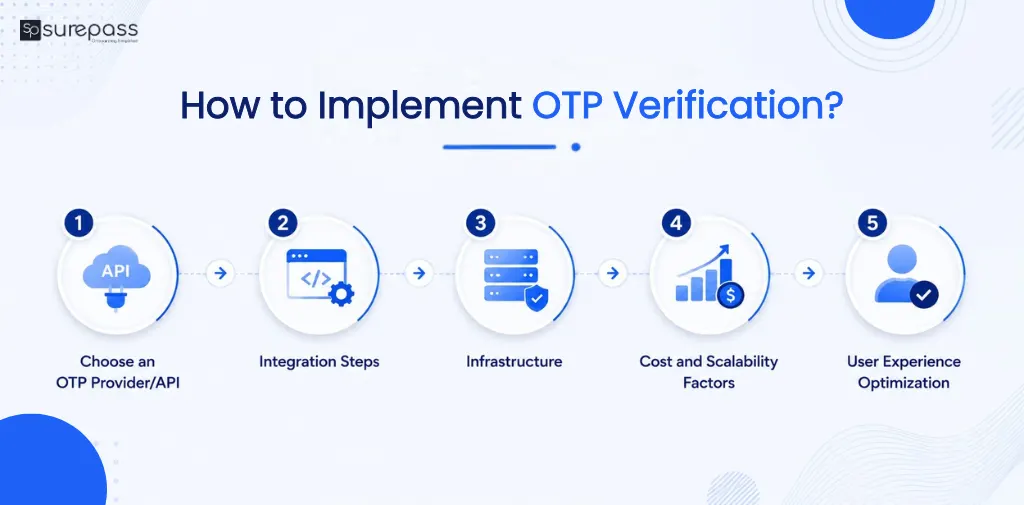
Follow these steps to implement OTP Verification:
- Choose an OTP Provider/API: Select a reliable provider that offers fast delivery (SMS, email, WhatsApp, etc.), strong uptime, and easy integration. Check pricing, global reach, and security features.
- Integration Steps
- User enters phone/email
- System generates OTP
- Send OTP via API
- User enters OTP
- Backend verifies and grants access
- Infrastructure: It confirms secure backend handling, encryption, rate limiting, and proper OTP storage.
- Cost and Scalability Factors: Consider per OTP cost, volume pricing, and regional charges. It ensures the system can handle high traffic.
- User Experience Optimization: It keeps short and quick to deliver, enables auto-read, allows resend option, and reduces friction.
Use Cases of OTP Verification
OTP verification is mainly used in various sectors:
- Banking and Fintech: Banking and financial institutions use OTP verification for UPI payments, fund transfers, and account logins to secure transactions and prevent unauthorized access.
- E-commerce Platforms: E-commerce platforms use this verification method for the checkout process. It ensures that the user is genuine before purchase.
- Telecom and SIM Activation: It is used for mobile number verification, SIM activation, and SIM binding.
- Edtech Platforms: This kind of verification can be used for student login verification while accessing apps.
- Healthcare System: Verification confirms that a genuine user is accessing the patient data and appointment logins.
Conclusion
OTP verification is a simple method to protect users and businesses. This adds an extra layer of security and ensures that only genuine users get access, helping prevent fraud, fake accounts, and unauthorized transactions.
However, OTP verification also has a few challenges, such as delivery delays or misuse. Following the right techniques, such as short expiry time, retry limits, and multi-channel delivery. It makes OTP systems secure. It can be used in combination of mutli-factor authentication
FAQs
Ques: What is OTP Verification?
Ans: It is a security verification process in which a temporary security code is sent to the user’s registered mobile number for verification.
Ques: How long is an OTP Valid?
Ans: It is generally valid for 30 seconds to a few minutes.
Ques: Is OTP Verification Secure?
Ans: Yes, OTP is secure as it involves verification through a temporary password.
Ques: What is the difference between OTP and MFA (Multi-Factor Authentication)?
Ans: OTP is a type of authentication process. On the other hand, MFA combines two or more factors (password + OTP + biometrics).
Ques: What is the difference between TOTP and HOTP?
Ans: TOTP (Time-Based OTP): It expires after a fixed time interval.
HOTP (Counter-based OTP): It is valid until it is used, depending on the counter system.
Automate your KYC Process & Reduce Fraud!
We have helped 3000+ companies in reducing Fraud by 95%