


GST verification by GSTIN means checking a 15-digit GST number on the official GST portal to confirm that a business is genuinely registered. Visit gst.gov.in, click Search Taxpayer, enter the GSTIN, and you get the legal name, registration status, and business type within seconds. It is free and needs no login.
Picture this: a credit manager at an NBFC is processing an MSME loan file. The borrower’s invoices look clean. Turnover claims look healthy. But when the team runs the GSTIN through the portal, the status shows cancelled. The registration was dead months before those invoices were even raised. The file that looked ready for approval was built on paper.
This is not a rare situation. Since the government began working against fake registrations in May 2023, officers have detected 29,273 bogus firms involved in suspected input tax credit fraud of Rs 44,015 crore. A 60 second check identifies most of these cases before any transaction. Press Information Bureau
What Is GST Verification by GSTIN?
Every business registered under GST gets a unique 15-digit number called the GSTIN (Goods and Services Tax Identification Number). GST verification by GSTIN is simply the process of entering that number on the official GST portal and confirming that it is real, active, and actually belongs to a genuine business.
You do not need to be a tax expert to do this. Anyone can verify any GSTIN, anytime, for free.
How to Do GST Verification by GSTIN on the GST Portal?
Follow these steps:
- Go to www.gst.gov.in
- Click on Search Taxpayer in the top menu
- Select Search by GSTIN/UIN
- Type the 15-digit GSTIN
- Enter the captcha and click Search
The result appears instantly. No login, no fee, no limit on how many numbers you check.
Automate your KYC Process & Reduce Fraud!
We have helped 3000+ companies in reducing Fraud by 95%
Why You Should Verify a GST Number?
It confirms the business actually exists: For a lender, this is the first legitimacy check on any business borrower. A GSTIN that fails on the portal means the entity either never existed or is no longer operating.
Turnover claims need a registered base: Borrowers often quote sales figures to support loan applications. Those figures mean nothing if the GSTIN behind them is fake, cancelled, or belongs to someone else.
Input tax credit depends on it: A business can claim ITC only if its supplier is genuinely registered and has paid the tax. If the supplier’s GSTIN is fake, the credit gets reversed and interest applies at 18 percent.
Fake invoice rings are active: Fraudsters create shell firms, issue invoices without supplying anything, and pass on fake credit. Anyone touching those invoices, buyer or lender, inherits the risk.
How to Read a GSTIN?
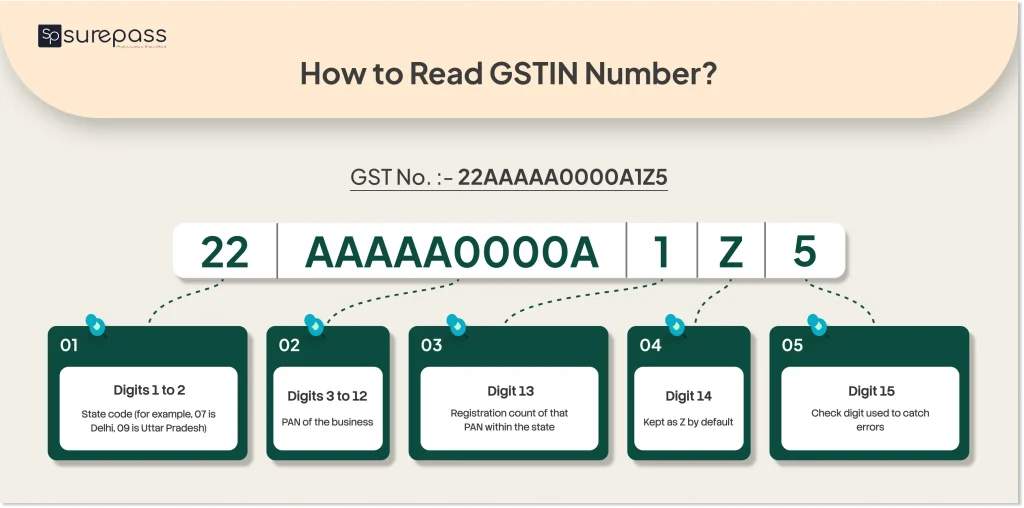
A GSTIN is not a random number. Each part means something. Take the sample format 22AAAAA0000A1Z5.
| Position | What It Means |
| Digits 1 to 2 | State code (for example, 07 is Delhi, 09 is Uttar Pradesh) |
| Digits 3 to 12 | PAN of the business |
| Digit 13 | Registration count of that PAN within the state |
| Digit 14 | Kept as Z by default |
| Digit 15 | Check digit used to catch errors |
Two quick checks you can do even before opening the portal. First, the state code should match the state in the business address. Second, digits 3 to 12 should match the PAN shared in the application or KYC documents. If either does not match, conduct verification.
What Does Each Detail Tell You?
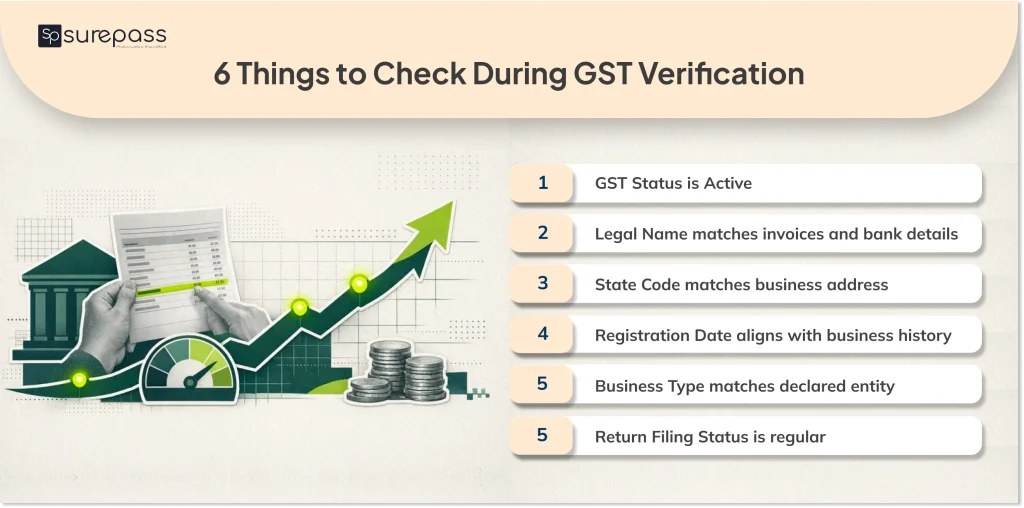
GSTIN status. Active means the registration is valid. If you are searching GST Verification by GSTIN and it shows Cancelled or suspended, it means stop right there and ask questions.
Legal name and trade name. The legal name must match the name on the invoice, the loan application, and the bank account receiving funds. Mismatches are how impersonation slips through.
Registration date: A GSTIN registered three months ago claiming Rs 8 crore annual turnover deserves a much closer look.
Constitution of business. Tells you whether it is a proprietorship, partnership, or company, which should match what the applicant declared.
Taxpayer type: A composition taxpayer cannot charge GST on invoices. If a composition dealer’s invoices show GST added, those invoices are wrong, and any credit claimed on them is invalid.
Return filing status: Click Show Filing Table on the result page to see whether the business has been filing its returns. Regular filing signals discipline. Long gaps signal stress or a shell entity.
What are the Red Flags of Fake GSTIN?
- Portal shows no record: The number simply does not exist.
- Status shows cancelled or suspended: Any invoice dated after cancellation is invalid.
- Name mismatch: The legal name on the portal differs from the invoice or application.
- State code mismatch: The GSTIN starts with one state’s code, but the declared address sits in another, with no valid explanation.
- A composition dealer charging GST: Not allowed, and a sign that the person does not understand or does not care about the rules.
If you find a fake GSTIN, report it through the GST grievance portal or the GST helpdesk. Under Section 122 of the CGST Act, running a fake registration can bring a penalty of Rs 10,000 or the tax amount involved, whichever is higher, and serious cases lead to arrest.
Conclusion
Verifying a GST number is essential to detect fake, invalid, or inactive GST. The above step-by-step guide helps you conduct GST verification by GSTIN through the official GST portal. On verification, you get verified details related to the GST number, which helps you avoid doing business with a fake entity and compliance issues. If you find a fake GST, you can report it to the grievance portal or contact the helpdesk.
FAQs
Ques: Is GST Verification by GSTIN Free?
Ans: Yes, GST portal is completely free and does not ask for a login.
Ques: How to Verify GST Online?
Ans: Just follow these steps to verify GST Online:
- Go to the GST Portal
- Click on the Search Taxpayer Tab
- Click on Search by GSTIN/UIN
- Enter the GSTIN
- Click on Search
Ques: Can I Verify a GST Number Without the GSTIN?
Ans: Yes. The portal has a Search by PAN option, which lists all GSTINs linked to that PAN.
Ques: What Does Suspended Status Mean?
Ans: It means the registration is under cancellation or facing a compliance issue. Do not treat a suspended GSTIN as safe.
Ques: Can GST Data Be Used for Loan Underwriting?
Ans: Yes, GST returns show declared turnover, filing regularity, and buyer-supplier patterns, which makes them one of the most reliable data sources for MSME credit assessment.
Ques: How Often Should a GSTIN Be Reverified?
Ans: Verify at application, then recheck during the loan lifecycle. A GSTIN that was active at disbursal can be cancelled a year later.
Automate your KYC Process & Reduce Fraud!
We have helped 3000+ companies in reducing Fraud by 95%