


Checking the CIN Number of a company is essential because it helps verify the company’s legal existence and registration with the Ministry of Corporate Affairs (MCA) in India. It helps prevent fraud, identify fake companies, and verify important details such as the company’s registered name, incorporation date, registration status, and registered office. It is an essential part of vendor and customer due diligence. This guide helps in checking CIN number of the company from the available methods.
What is CIN (Corporate Identification Number)?
CIN or corporate Identification Number is a unique 21-alphanumeric code assigned to companies. It is registered in India under the Companies Act by the Registrar of Companies (ROC), governed by the Ministry of Corporate Affairs (MCA).
It is proof of the identity of a company and helps in tracking all its activities with the ROC. This number is assigned to
- PLCs (Private Limited Companies).
- OPCs (One Person Companies).
- Companies owned by the Government of India.
- State Government Companies.
- Not-for-Profit Section & Company.
- Nidhi Companies.
CIN Format: The 21-digit code is divided into 6 sections.
- Listing Status: The first character indicates the company is listed (L) or unlisted (U) on a stock exchange.
- Industry Code: The next five digits represent the industry classification code based on the company’s primary business activity.
- State Code: The Next two letters denote the state or union territory where the company is registered.
- Year of Incorporation: The next 4 digit show the year in which the company was incorporated.
- Company Type (Next 3 Letters): These 3 letters specify the type of company, such as PTC for Private Limited Company, etc.
- Registration Number: A 6 digit unique number is assigned by the Registrar of Companies (ROC) to identify the entity.
Automate your KYC Process & reduce Fraud!
We have helped 200+ companies in reducing Fraud by 95%
How to do CIN Number Check?
Follow the steps below to check the CIN number online:
MCA Portal
- Visit the MCA Portal.
- Go to the MCA service, then View Company/LLP Master Data.
- Enter the exact registered name of the company in the search bar.
- Enter the Captcha code displayed.
- Click on the submit button.
- Get the CIN number along with other details.
Importance of CIN Number
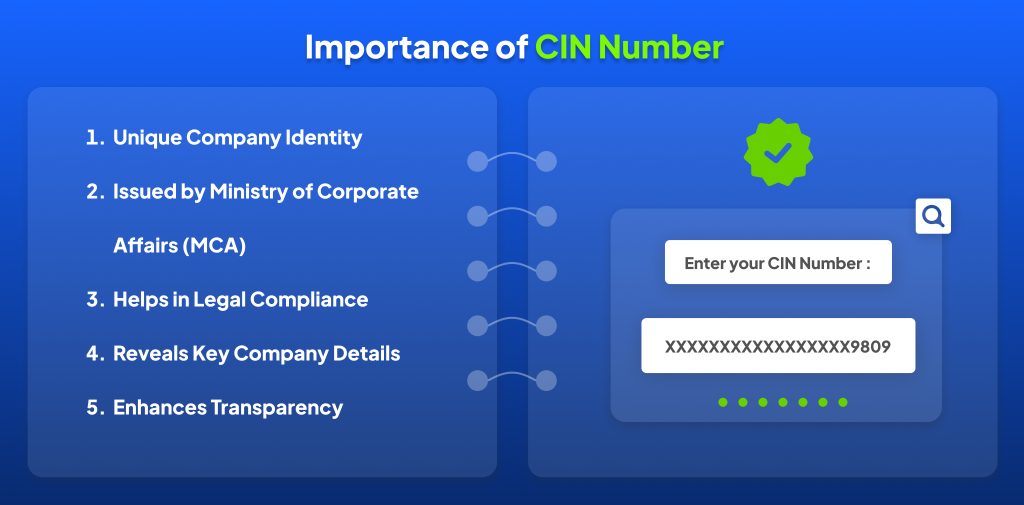
The corporate identification number (CIN) is essential for every company registered under the Companies Act in India. Here, why it matters:
- Unique Identity for Corporate: CIN is a unique identifier for registered companies, just like Aadhaar, a unique identifier of individual identity.
- Mandatory for Official Documentation: All companies must include their CIN on official documents, such as letterheads, invoices, emails, receipts, and forms submitted to government bodies.
- Transparency: It allows customers, vendors, and investors to verify the legal status and background of a company. It helps in background verification.
- Company Monitoring: CIN encodes valuable information, including the type of company, year of incorporation, state of registration, and ROC jurisdiction.
Who needs CIN and when?
You can check the CIN (Corporate Identification Number). It can be useful in many professional and legal situations.
Investors Verifying a Company
- It confirms that the company is legally registered.
- Review its incorporation, year, type, and Jurisdiction.
- Access financial filings via the MCA portal.
Legal or Audit Firms During Due Diligence
- During M&A, fundraising, or compliance audits, professionals.
- Get company filings, directorships, and compliance status.
- Evaluate legal standing and operational history.
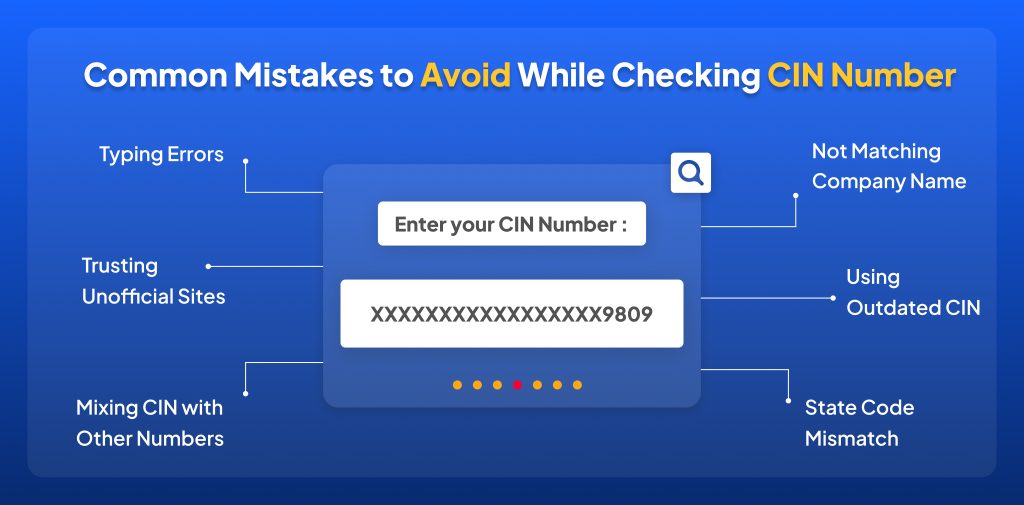
Common Mistakes to Avoid While Checking CIN Number
Even though checking a CIN is simple,
- Using the wrong or misspelled company Name:
A minor spelling mistake or an outdated company name can lead to no results. Always double-check the official name as registered with the MCA.
- Assuming LLPs have CINs:
CIN is issued only to companies registered under the Companies Act, and LLPs (Limited Liability Partnerships) receive an LLPIN (LLP Identification Number) instead.
- Using CIN in Place of GSTIN
GST filings need a GSTIN, not a CIN Mixing these up can lead to incorrect filings and possible compliance issues.
Conclusion
The CIN (Corporate Identification Number) is essential to confirm the legitimacy of a registered company. Checking the validity of CIN confirms that you’re working with a legitimate firm and helps avoid fraud. You can follow the above guide to check the Corporate Identification Number from the MCA portal as well as the other trusted platforms, such as Tofler, ZaubaCorp, and QuickCompany.
FAQs
Ques: How can I check if a CIN number is real or fake?
Ans: You can check the CIN Number via the MCA portal; just go to the site, under MCA services, click on View Company/LLP Master Data, enter the CIN, and get details. If the CIN is genuine, details will be shown. If nothing is found, or the details don’t match, it may indicate the CIN is fake. But before making any decision, go for further verification.
Ques: Do LLPs have a CIN?
Ans: No, LLPs are registered under the LLP Act and receive an LLPIN (LLP Identification Number) instead of a CIN.
Ques: Can two companies have the same CIN?
Ans: No, two companies cannot have the same CIN. Each company gets a unique CIN whenever registered.
Ques: Does a struck-off company still have a CIN?
Ans: Yes, a struck-off company still has its CIN. But the status on the Ministry of Corporate Affairs (MCA) portal will reflect that it has been struck off.
Ques: Do the branches and offices of a company have separate CINs?
Ans: No, a company has one CIN, and its branches and offices all use it.
Automate your KYC Process & reduce Fraud!
We have helped 200+ companies in reducing Fraud by 95%