


Every bank, NBFC, and fintech in India runs into the same wall at some point: KYC. Every single customer has to be verified before they can open an account, take a loan, or buy a policy, and doing this manually is slow, repetitive, and expensive. This is exactly the gap that a CKYC API fills. It lets financial institutions search, fetch, upload, and update a customer’s Central KYC record in real time, through one simple integration, instead of chasing paperwork every time.
In this blog, we will break down what a CKYC API actually does, why it exists, and how it fits into a modern onboarding stack.
The Problem the Industry Was Facing
Before Central KYC came along, every bank, NBFC, and insurer kept its own separate KYC records. If a customer had already completed KYC with one bank, another bank had no way of knowing this. So the same person ended up submitting the same PAN card, Aadhaar, and address proof again and again, at every new institution they dealt with.
This created three big problems for the industry:
- Repetitive paperwork for customers, which slowed down onboarding and hurt the experience.
- Duplicate records across institutions, making it hard to get one accurate view of a customer.
- Higher compliance risk, since manual, paper-based KYC was harder to track, audit, and verify against RBI norms.
To fix this, the Reserve Bank of India set up the Central KYC Registry (CKYC), managed by CERSAI, as a single, shared repository of KYC records for the entire financial sector. Once a customer’s KYC is uploaded to this registry, any other regulated institution can search and fetch it with the customer’s consent, instead of asking them to redo it.
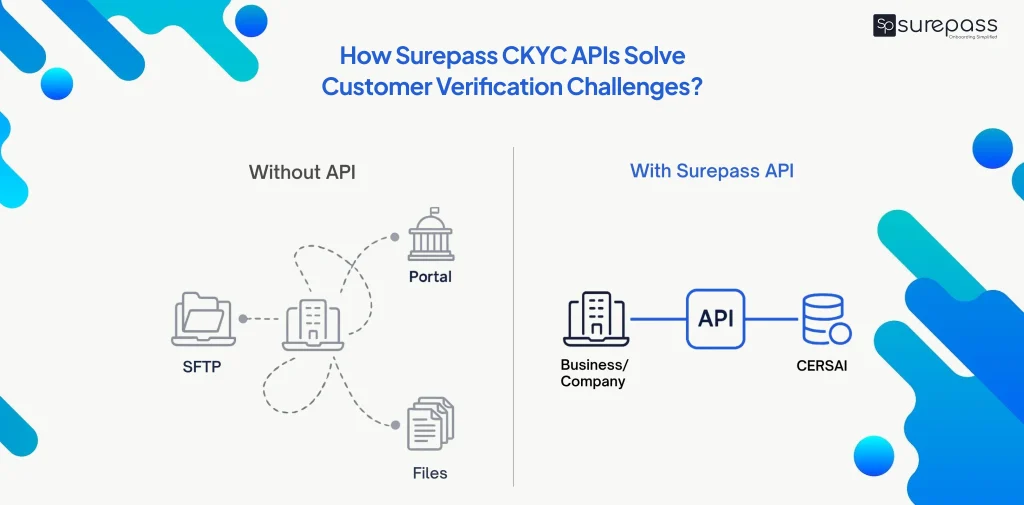
How Surepass CKYC APIs Solve Customer Verification Challenges?
A CKYC API is the technical bridge between a business’s onboarding system and the CERSAI CKYC registry. Rather than manually logging into government portals or managing files over SFTP, businesses can connect once through an API and handle their entire CKYC workflow programmatically.
The Surepass CKYC API brings CKYC Search, CKYC Download, CKYC Upload, and CKYC Update together on a single platform, so teams do not need to integrate multiple separate tools to manage one customer’s KYC lifecycle. It is built for banks, NBFCs, fintechs, and insurance providers who need to onboard customers quickly while staying fully compliant with RBI and SEBI guidelines.
How Does the CKYC API Work?
The CKYC process, from onboarding to record management, generally follows four steps:
1. Search: Before creating a new record, the business checks whether the customer already has a CKYC record, using their PAN, Aadhaar, Driving Licence, or CKYC number. This single check prevents duplicate record creation and shows the current KYC status.
2. Download: If a record already exists, the business can pull the complete, verified KYC record using the CKYC number and date of birth, with the customer’s consent. Identity, address, and document details come back in a clean JSON format that plugs straight into onboarding systems, so the customer does not need to submit documents again.
3. Upload: If no record exists, the new customer’s KYC details are formatted correctly and uploaded to CERSAI. This step involves specific data formatting rules, and the API handles the conversion, submission, retries, and status tracking behind the scenes.
Automate your KYC Process & Reduce Fraud!
We have helped 3000+ companies in reducing Fraud by 95%
4. Update: Whenever a customer’s address, contact details, or documents change, the existing CKYC record can be updated directly, with smart PAN and date-of-birth matching to keep updates accurate.
Together, this gives businesses one dashboard to manage a customer’s KYC from first onboarding to any future update, without switching between multiple tools or manual processes.
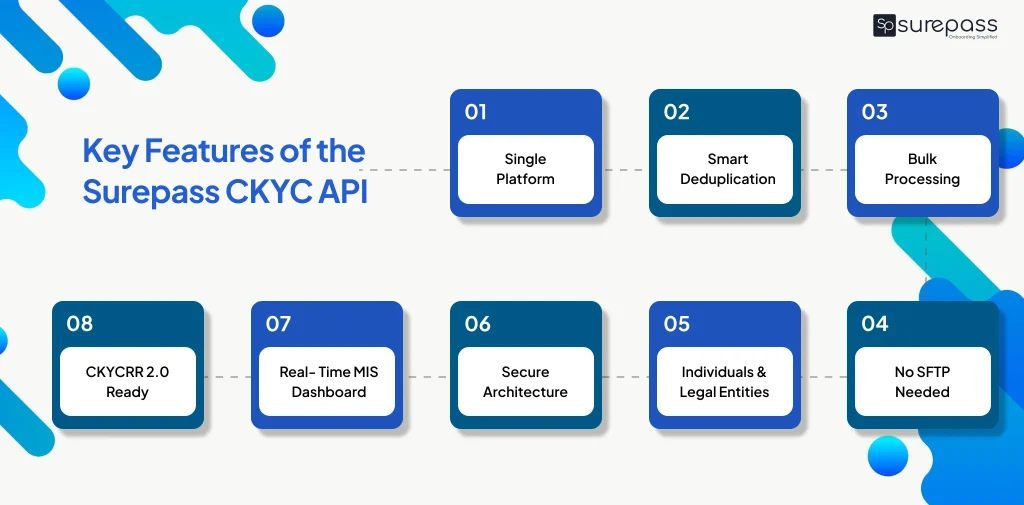
Key Features of the Surepass CKYC API
- Single platform for CKYC Search, Download, Upload, and Update, so there is no need to juggle separate integrations.
- Smart deduplication that flags existing records before a new one is created.
- Bulk processing that supports 10,000+ records at once, useful for institutions running large onboarding drives.
- No SFTP management, removing a legacy pain point of the older CKYC upload process.
- CKYCRR 2.0 ready workflows, keeping businesses aligned with the latest CERSAI format changes.
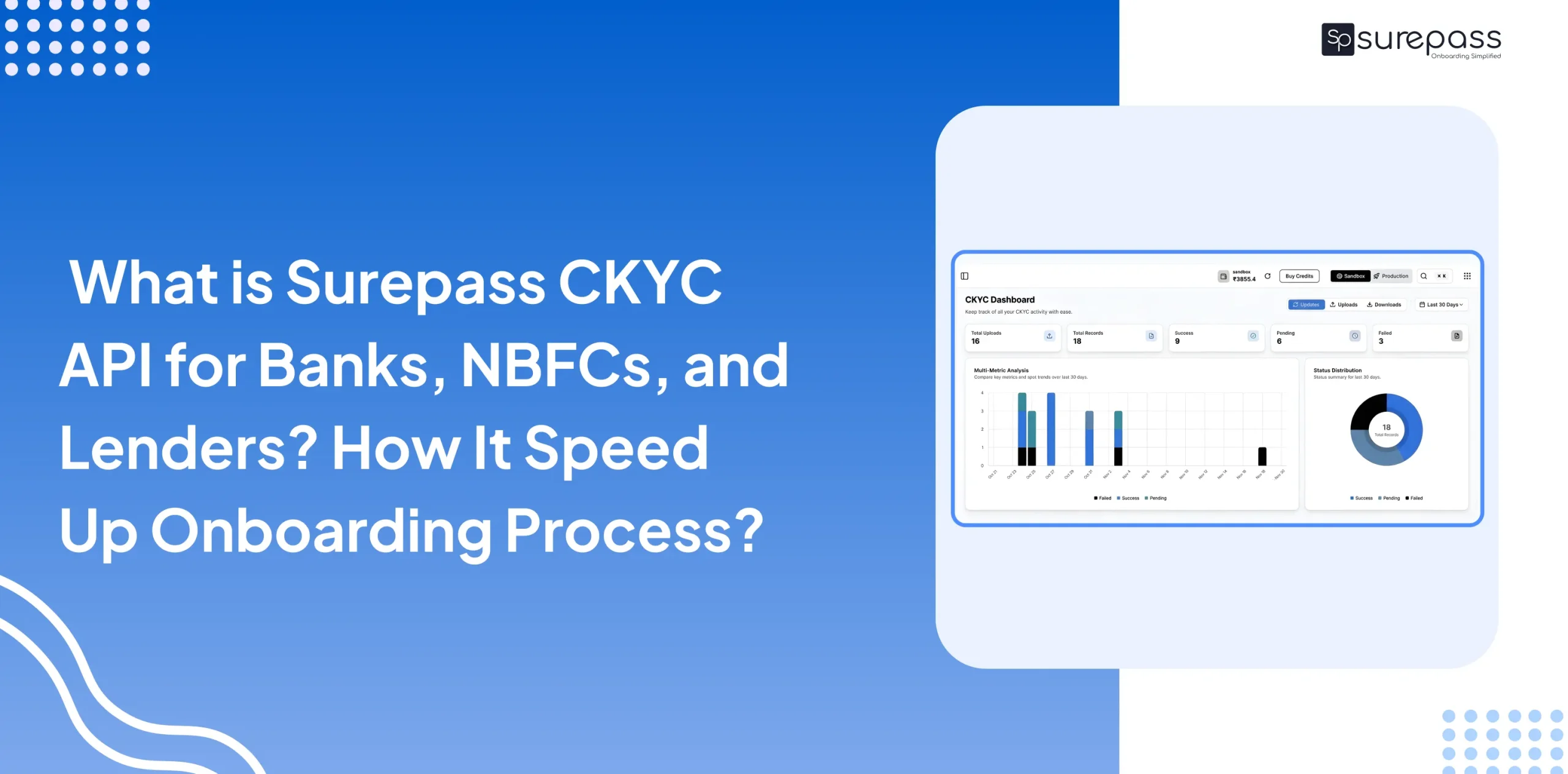
- Real-time status visibility through clean MIS dashboards, so teams always know where a record stands.
- Secure architecture with encryption, audit logs, and IP-level controls to protect sensitive customer data.
- Support for individuals and legal entities, covering companies, LLPs, partnerships, and trusts alongside regular customer KYC.
What Does the Surepass CKYC API Suite Include?
Surepass covers the full CKYC lifecycle. Each API handles a specific part of the workflow.
CKYC Search API: Searches the CERSAI registry using PAN, Aadhaar, or other identifiers to check if a customer already has a CKYC number. Reduces duplicate registrations and needless document collection.
CKYC Verification API: Verifies an existing CKYC number to confirm a customer’s identity. Useful when a customer gives you their KIN, and you need to validate it before moving ahead.
CKYC Download API: Pulls a customer’s full KYC record from CERSAI using their CKYC number. Returns structured data covering personal details, address, documents, and photographs.
CKYC Upload API: Submits new or updated KYC records to CERSAI. The API handles formatting, validation, and submission on its own.
CKYC Bulk Download API: Downloads multiple KYC records in a single operation. Built for institutions processing large customer volumes.
CKYC Card Verification API: Verifies the details on a customer’s CKYC card, including the KIN. Confirms authenticity during in-person or digital onboarding.
Legal Entity CKYC API: Handles CKYC for companies, partnerships, trusts, and other non-individual entities. Covers the full business onboarding workflow.
Conclusion
CKYC exists to solve a real, everyday problem: customers should not have to prove who they are, again and again, at every financial institution they use. A CKYC API takes this shared registry and makes it usable inside real onboarding systems, through a single, developer-friendly integration.
If you’re evaluating how to bring CKYC Search, Download, Upload, and Update into your onboarding stack, it’s worth understanding these building blocks first — we’ll go deeper into each API, and specific use cases, in the posts that follow in this series.
FAQs
Ques: What Is CKYC?
Ans: CKYC stands for Central Know Your Customer. It is a centralized registry run by CERSAI where regulated financial institutions store and access customer KYC records. A customer completes KYC once, gets a KIN, and other institutions retrieve that record instead of collecting documents again.
Ques: What Is a KIN?
Ans: KIN stands for KYC Identification Number. It is a 14-digit unique number assigned when a customer is registered in the CKYC registry. Any regulated institution can use it to pull the customer’s verified KYC data.
Ques: What Is the Difference Between KYC and CKYC?
Ans: KYC is done at the institution level, where each bank or NBFC keeps its own records. CKYC is centralized, so all regulated entities share a single verified record per customer. CKYC removes the need for every institution to collect documents on its own.
Ques: What Is CKYC 2.0?
Ans: CKYC 2.0 is the updated framework mandated by CERSAI. It brings JSON-based record structures, stricter validation, Aadhaar masking, facial de-duplication, and real-time API submissions. Regulated institutions are required to upgrade to it.
Ques: Which Institutions Need to Comply With CKYC?
Ans: All entities regulated by RBI, SEBI, IRDAI, or PFRDA. That covers banks, NBFCs, insurance companies, mutual funds, and fintechs.
Ques: Does the Surepass CKYC API Support a Sandbox?
Ans: Yes. You get full sandbox access to test every endpoint against sample data before going live. The production switch uses the same endpoints, so nothing in your integration changes.
Ques: Can I Get Real-Time Submission Status?
Ans: Yes. Register a webhook and Surepass posts the CERSAI result back to your endpoint as soon as it is available. You do not have to poll for status.
Ques: Does Surepass Support CKYC for Companies and Legal Entities?
Ans: Yes. The Legal Entity CKYC API handles KYC for companies, partnerships, trusts, and other non-individual entities.
Automate your KYC Process & Reduce Fraud!
We have helped 3000+ companies in reducing Fraud by 95%