


Being GST compliant is very important for businesses running in India. And to avoid issues in tax filing it is very important for businesses to know the difference between GSTR 2A and GSTR 2B. You might be wondering What is GSTR 2A and 2B? And more importantly, which document dictates your tax savings? In this guide, we will explain the difference between GSTR 2A and 2Bso that you can understand these things easily.
What is GSTR 2A?
GSTR 2A is an auto-generated statement of your business purchases. Whenever your vendors and suppliers file their sales returns (GSTR 1), the invoices they upload automatically get added to your GSTR 2A. This helps in:
- Real-time updates: This is the defining characteristic of GSTR 2A. It functions as a live ledger. If a vendor delays uploading an invoice today but completes it tomorrow, your GSTR 2A updates immediately to reflect that new data.
- Reflects Purchase Data: It mirrors the purchase data precisely as your suppliers have reported it to the government.
Think of it like a news channel that broadcasts headlines whenever a vendor files their GSTR1
Automate your KYC Process & Reduce Fraud!
We have helped 3000+ companies in reducing Fraud by 95%
What is GSTR 2B?
GSTR 2B is also an auto-generated statement of your purchases, but it operates with one fundamental distinction: It is static. It is generated strictly, on the 14th day of every month. This gives:
- Fixed snapshot: Once GSTR 2B is generated for a specific month, the data is locked. If a supplier uploads a late invoice on the 15th, it will not alter your current month’s GSTR 2B; instead, it rolls over to the next month’s statement.
- Clear ITC Eligibility: GSTR 2B explicitly categorizes which invoices are eligible for Input Tax Credit (ITC) and which are ineligible, removing ambiguity from your tax planning.
If GSTR2A is like a news channel, GSTR2B is like a newspaper which you get once a month, and any information present on it cannot be updated.
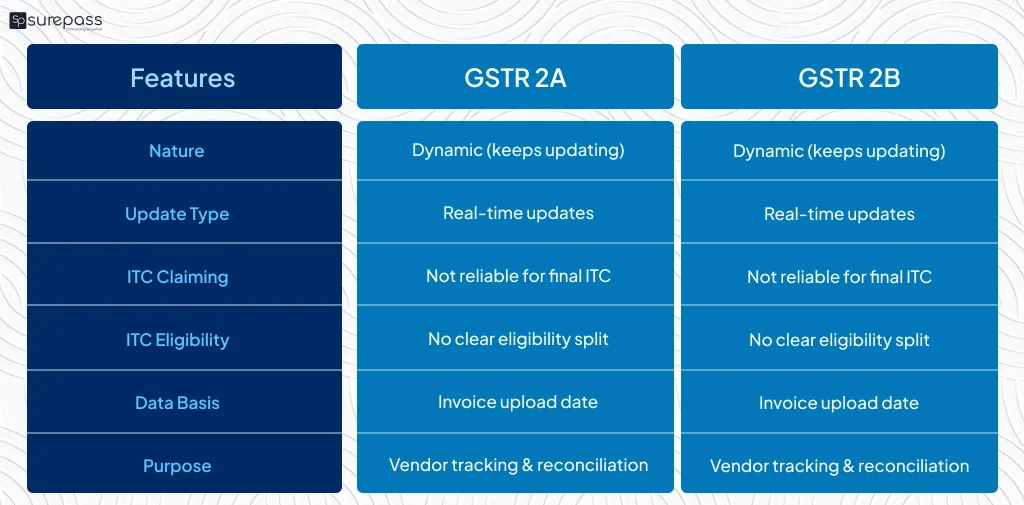
Difference Between GSTR 2A and GSTR 2B
To streamline this for your finance department, here is a concise breakdown of the core difference between GSTR 2A and 2B.
| Feature | GSTR 2A | GSTR 2B |
| Nature of Document | Dynamic (Continuously updating) | Static (Fixed snapshot, locked upon generation) |
| Real-time vs Fixed | Updates in real-time as vendors file their returns. | Generated on a fixed schedule (14th of the following month). |
| ITC Claiming | Cannot be used to determine your final monthly ITC claim. | Must be used as the authoritative source for claiming ITC. |
| ITC Eligibility | Does not provide a clear split between eligible and ineligible ITC. | Explicitly marks the eligibility status of every invoice for ITC. |
| Data Source | Reflects data based on the date the invoice was issued. | Reflects data based on the date the supplier actually filed the return. |
| Primary Use Case | Vendor management, tracking compliance, and resolving missing invoices. | Strict tax compliance and filing the monthly GSTR-3B return. |
GSTR 2A vs 2B: Which One Should A Business Use?
Businesses must use both, but at different stages of the financial workflow.
When to use GSTR 2A: Deploy this throughout the month for vendor management. GSTR 2A is the ideal tool to audit supplier compliance. It allows your team to identify and follow up with vendors who are delayed in their GST filings, ensuring your future credits are secure.
When to use GSTR 2B: Rely on this strictly during tax filing. When your finance team prepares the GSTR-3B to claim Input Tax Credit, GSTR 2A should be set aside. Compliance laws require that your ITC claim strictly align with the fixed data in GSTR 2B.
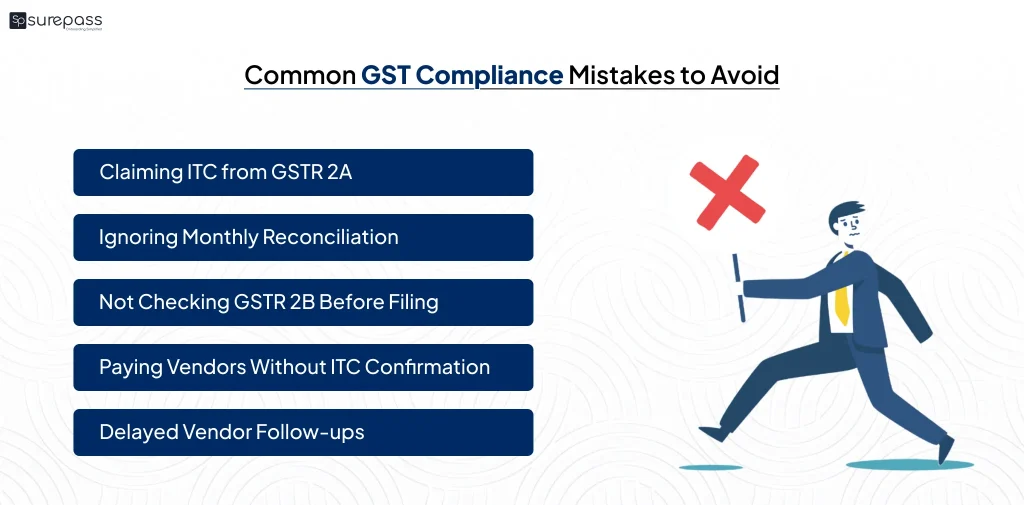
Common Compliance Mistakes to Avoid
Even sophisticated finance teams encounter friction with GST processes. Ensure your business avoids these costly errors:
- Claiming ITC based on GSTR 2A: This is a legacy practice that poses severe compliance risks. Regulatory updates have invalidated 2A for claiming ITC. Utilizing 2A instead of 2B will result in departmental notices, reversed credits, and financial penalties.
- Neglecting Regular Reconciliation: Failing to reconcile your internal ERP data with government portals monthly means your business is likely leaving valuable tax credits and therefore working capital on the table.
- Releasing Full Payments Prematurely: Many optimized enterprises hold back the GST portion of a vendor’s payment until that specific invoice successfully reflects in the company’s GSTR 2B, incentivizing vendor compliance.
Conclusion
Understanding the difference between GSTR 2A and 2B is important for all businesses. GSTR 2A tracks business expenses throughout the year while GSTR 2B provides a monthly fixed report. Use GSTR 2A to manage your vendors and audit their reporting accuracy and GSTR 2B as your single source of truth for claiming Input Tax Credit and filing final returns. The two tax filings allow businesses to stay compliant and reduce penalty risk and their process of obtaining tax deductions becomes simpler.
FAQs
Ques: Can a business claim ITC if an invoice appears in GSTR 2A but not in GSTR 2B?
Ans: No, ITC can only be claimed on invoices verified in GSTR 2B. If an invoice appears in GSTR 2A but not in 2B it means that the vendor sent the invoice after the cutoff date for that month and will only be shown when the next GSTR 2B report is generated.
Ques: Why was GSTR 2B implemented when GSTR 2A already existed?
Ans: The government introduced GSTR 2B to give businesses a fixed way to present their business expenses and standardize how much ITC can be claimed in a month.
Ques: What is the exact cutoff for GSTR 2B generation?
Ans: GSTR 2B is auto-generated on the 14th day of every month. It aggregates all supplier filings submitted up to midnight of the 13th.
Ques: Do finance teams need to manually input data into GSTR 2A or 2B?
Ans: No manual entry is required on GSTR 2A and 2B forms. They are auto-generated by the GST council’s systems by drawing data directly from the sales returns (GSTR 1) filed by business vendors.
Ques: Why is GSTR 2A important?
Ans: GSTR 2A is important for live-tracking of business transactions and vendor management.
Automate your KYC Process & Reduce Fraud!
We have helped 3000+ companies in reducing Fraud by 95%