




Online document signing has become common for individuals and businesses. However, many people still get confused between eSign and a digital signature.
An electronic signature is simple and suitable for basic agreements. A digital signature is secure and mandatory for many official processes like tax filing, corporate filing, and other government documentation work . Knowing the difference between a digital signature and an electronic signature helps you choose the right one.
What is an Electronic Signature or eSign?
An electronic signature is a simple digital method used to indicate a person’s agreement or approval on an online document. It can be typed as your name, a scanned handwritten signature, a tick box, or clicking an “I agree button to show the consent.
It is commonly used for forms, contracts, agreements, and approvals. It helps businesses sign documents easily without printing, scanning, or meeting in person.
Automate your KYC Process & Reduce Fraud!
We have helped 3000+ companies in reducing Fraud by 95%
What is a Digital Signature?
A digital signature is a cryptographic security mechanism used to prove who signed the document and prevent tampering. It works using special security technology and needs a DSC (Digital Signature Certificate).
When a person signs a document digitally, a secure code is created and attached to both the signer and the document. If the document is changed after signing, the signature becomes invalid.
A digital signature helps confirm the signer’s identity and protects the document from tampering. A signer cannot deny signing. They are commonly used in income tax filing, GST returns, MCA filings, government tenders, etc.
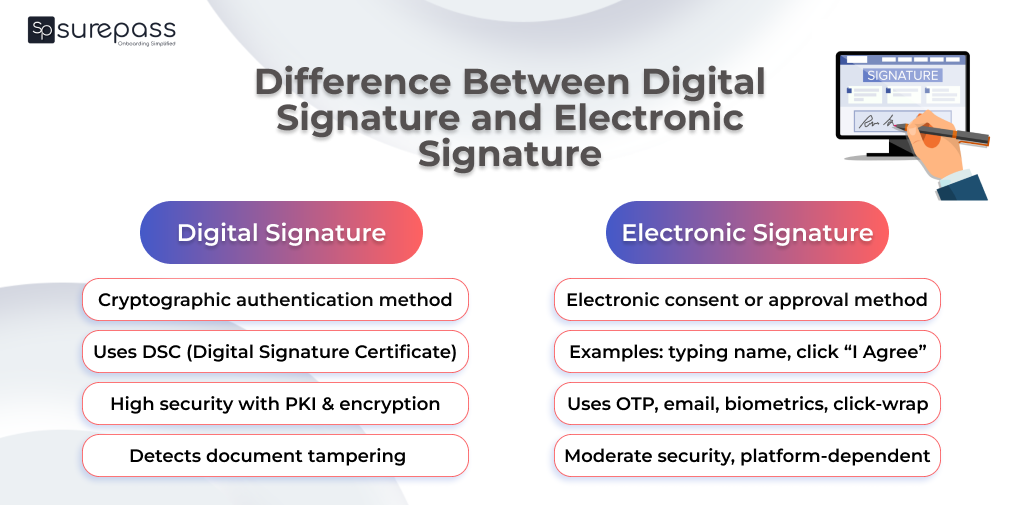
Difference Between Digital Signature and Electronic Signature
These are the main differences that help you find the difference between electronic signature and digital signature:
Meaning
- Digital Signature:
A cryptographic method used to verify the authenticity of a document. It is issued using a DSC (Digital Signature Certificate).
- Electronic Signature:
Any electronic method used to indicate consent or approval. It can be as simple as typing a name or clicking on I agree on web platforms.
Security difference between Digital Signature and Electronic Signature
- Digital Signature:
It is highly secure, uses encryption, and public key infrastructure (PKI). It helps in identifying document tampering attempts.
- Electronic Signature
It has moderate security. It depends on the platforms and the authentication method used.
Legal Validity: Difference between Electronic Signature and Digital Signature
Digital Signature
A Digital signature is legally valid under the Information Technology Act, 2000 (India). It is mandatory for many government and regulatory application processes.
Electronic Signature
eSign is also valid under the IT Act, 2000, but with some conditions. It is accepted for most commercial and business agreements.
Use of technologies creates the main difference between Digital Signature and an Electronic Signature
- Digital Signature
- It uses cryptography, Public Key Infrastructure (PKI), and Hash algorithms.
- Electronic Signature:
- It uses electronic verification methods such as OTP, email verification, click-wrap, and biometrics.
Certificate Requirement
- Digital Signature:
- It requires a digital signature certificate (DSC). The license certifying authorities issue this certificate.
- Electronic Signature:
- No physical or digital certificate is required for eSign as it uses platform-based authentication.
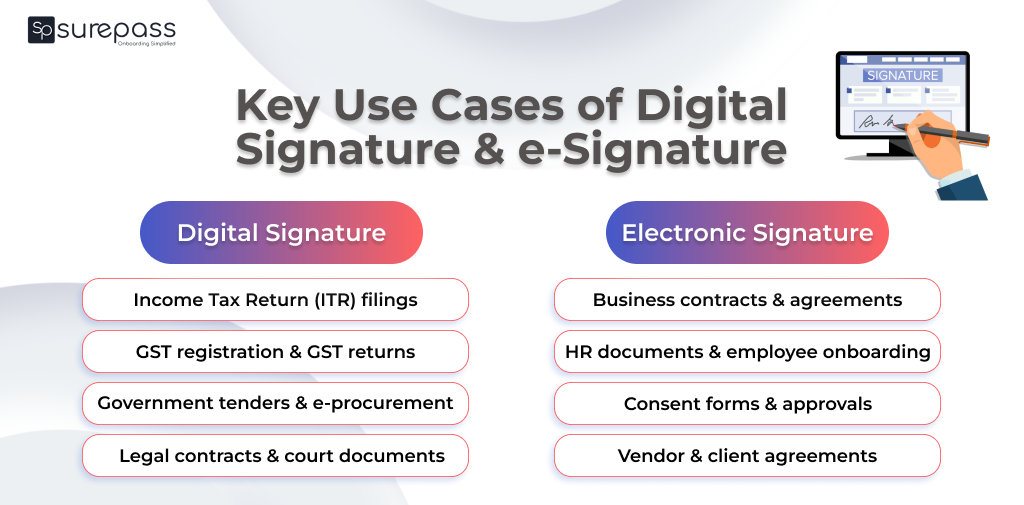
Use Cases
- Digital Signature:
- It is used by income tax returns, MCA filings, GST registration, GST returns, Government tenders, and legal documents.
- Electronic Signature
It is mostly used in business contracts, HR documents, consent forms, and agreements.
Verification Method
- Digital Signature: It is verified using the signer’s public key. The identity is confirmed via a Certifying Authority.
- Electronic Signature: It is verified through email, OTP, IP address, or audit trail. It depends on the service provider.
Are electronic and digital signature Same?
No, a digital signature and an electronic signature are not the same. Electronic means any action done using electronic devices. Examples, typing a name, ticking a checkbox, or clicking “I agree.”
Digital means a more secure, technology-based method that uses encryption and verification to protect data. For example, a digital signature that uses a certificate cannot be altered.
Which is better to choose: eSign or Digital Signature?
Choosing between eSign and a digital signature totally depends on your purpose. An eSign is better when you want a quick and easy way to sign a document online. It is best for signing agreements, consent forms, or internal approvals. It is simple and does not need special hardware.
A digital signature is good for official, legal, and high-security work. It uses a digital signature certificate (DSC). It is required for income tax filings, GST returns, MCA filings, and government portals.
Conclusion:
Both digital signature and electronic signature sound similar. However, they serve different purposes. If we find the difference between the Digital Signature and the Electronic Signature, eSignatures are simple, fast, and suitable for everyday agreements and approvals. Digital Signatures are more secure and are required for official filings, legal documents, and government-related work. Both are valid under the IT Act, 2000; their level of security and technology is different. If you are confused between them, think about document sensitivity and legal requirements. The right signing method not only saves time but also protects you from legal and security risks.
FAQs
Ques: What is difference between digital signature and electronic signature?
Ans: A digital signature uses secure certificates for legal proof, while an electronic signature is a simpler online way to show consent or approval.
Ques: Is the internet required for a digital signature?
Ans: Yes, the internet is required to verify the digital signature.
Ques: Can I use a digital signature to sign contracts?
Ans: Yes, you can use a digital signature for contract signing.
Ques: Is eSign legally valid in India?
Ans: Yes, eSign is legally valid in India.
Ques: Do digital signatures require a certificate?
Ans: Yes, a digital signature required DSC issued by a Certifying Authority under the IT Act.
Automate your KYC Process & Reduce Fraud!
We have helped 3000+ companies in reducing Fraud by 95%