




A Fintech company faces many challenges in KYC, including user drop-offs due to verification delays, compliance issues, review errors, synthetic identities, and costly liveness detection and biometric tools. It can eliminate all these issues with offline Aadhaar verification. Here in the blog, you will learn how Fintech Companies can use Aadhaar Offline verification for secure KYC.
What is the Aadhaar OVSE Framework for Fintech?
Aadhaar OVSE in Fintech KYC is an OVSE framework that allows fintech companies to verify customer identities without connecting to the Central Identities Data Repository (CIDR). Fintech companies can easily verify identities via digitally signed QR codes, paperless XML files, e-Aadhaar, and verifiable credentials. It is cost-effective and reduces compliance burden.
How Fintech Companies Use Aadhaar OVSE for Offline KYC?
If a Fintech company wants to conduct offline KYC, it needs to obtain an OVSE registration certificate. After certification and technical integration from the UIDAI, a Fintech company will become eligible to conduct verification.
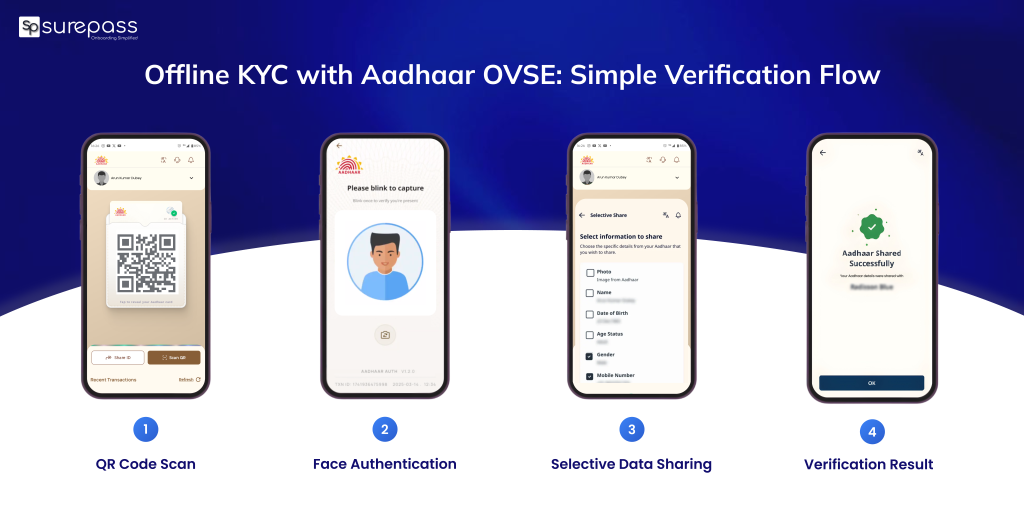
Here is how verification will be done:
- The user will scan the OVSE QR code from the Fintech Platform.
- After scanning, the User will receive a request for data sharing and verification.
- The user will select the necessary information.
- The entity will receive data for verification.
- On successful verification, verified messages will be displayed on the screen.
Why Do Fintech Companies Need Aadhaar Offline Verification?
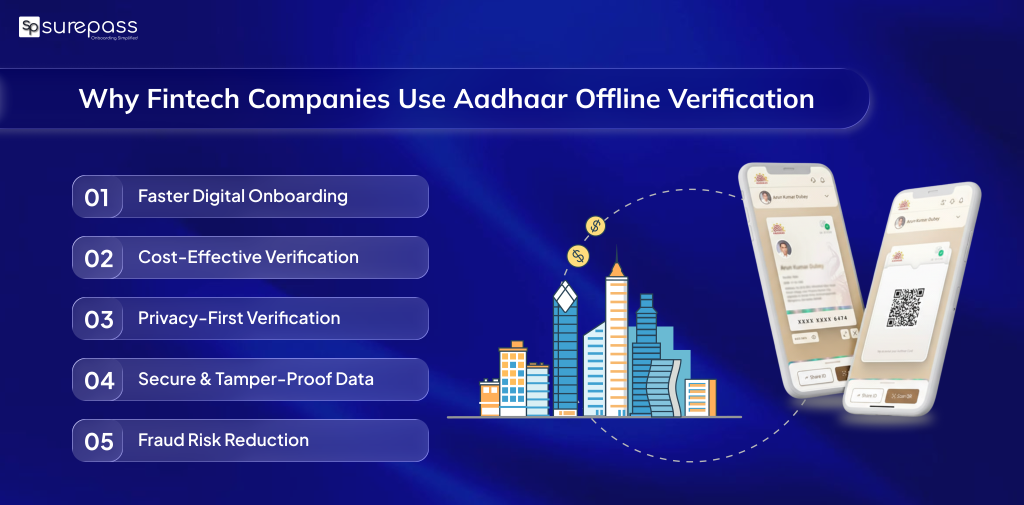
A fintech company can get various benefits from using offline verification:
- Growing Digital Customer Base: Fintech companies can onboard many users online. Aadhaar OVSE helps in quick identity verification and helps platforms scale without manual delays.
- Cost-effective Verification: Offline verification reduces the need for expensive infrastructure and a licensed eKYC system. It makes verification simple and cost-effective.
- Enhanced Customer Privacy: Users can easily verify identities without sharing sensitive details online.
- Reduce Risk of Fraud: The digitally signed credential ensures that the customer is genuine. It also reduces the risk of fake and manipulated documents.
Automate your KYC Process & Reduce Fraud!
We have helped 3000+ companies in reducing Fraud by 95%
Offline Verification Methods For KYC
These are the methods that Fintech Companies use Aadhaar OVSE for Secure KYC:
- QR Code Verification
This process involves scanning the QR code to receive demographic information for verification. It requires quick, in-person, or video-based, tamper-proof identification.
- Aadhaar Paperless eKYC (XML)
The Paperless eKYC is an encrypted Aadhaar information that contains demographic information. It is used for verification without sharing the Aadhaar number.
- e-Aadhaar Verification
Fintechs accept the electronic version of the Aadhaar card (e-Aadhaar). It is digitally signed and password-protected. It is used for secure customer onboarding.
- Verifiable Credentials and face authentication
The UIDAI New Aadhaar App allows Aadhaar holder to share their verified credential with the entity through QR scanning. The entities can confirm authenticity by verifying the credentials.
Which method is better: Aadhaar OVSE vs Online eKYC?
A Fintech company often gets confused between these two methods for verification:
- Internet Required
In Aadhaar online eKYC, companies need to access the CIDR database, which requires high internet connectivity. In offline verification, the companies can verify Aadhaar information via digitally signed data without accessing the CIDR database.
- Privacy
In online eKYC, full Aadhaar details are shared for verification. It needs high security to prevent a data breach. However, in offline verification, limited information is shared, which enhances privacy.
- Infrastructure
For offline verification, Fintech companies need a simple technical infrastructure. On the other hand, for online eKYC, a heavy technical infrastructure is required.
Conclusion
Fintech companies can use the OVSE framework for customer verification through 4 methods: QR scanning, Aadhaar XML, eAadhaar, and verified credentials. To conduct verification, fintech first needs to obtain the OVSE registration certificate. After approval and technical integration, offline verification can be done. A user simply visit Fintech platform, for KYC, they will scan the QR code, get a request for verification, and share details. The details will be verified against the details stored in the Aadhaar App during KYC.
FAQs
Ques: What is the KYC process in Fintech?
Ans: The KYC is a customer identity verification process. It prevents identity theft, money laundering, and other illegal activities.
Ques: Why do Fintech companies use Aadhaar offline verification for KYC?
Ans: Fintech companies use Aadhaar offline verification (XML/QR-based) for fast, secure, and paperless customer verification.
Ques: Do customers need to share Aadhaar numbers or biometrics with fintechs?
Ans: No, offline verification eliminates the need to share the Aadhaar number or biometrics via methods such as QR scanning, XML files, or verified credentials.
Ques: What methods can fintech companies use in Aadhaar offline KYC?
Ans: Fintech companies can easily verify customer identities via:
- Secure QR Code
- Offline XML File
- eAadhaar PDF
- Aadhaar App
Ques: Can Aadhaar OVSE prevent identity fraud in fintech?
Ans: Yes, the digitally signed UIDAI-approved information and face verification ensure accurate verification.
Automate your KYC Process & Reduce Fraud!
We have helped 3000+ companies in reducing Fraud by 95%