




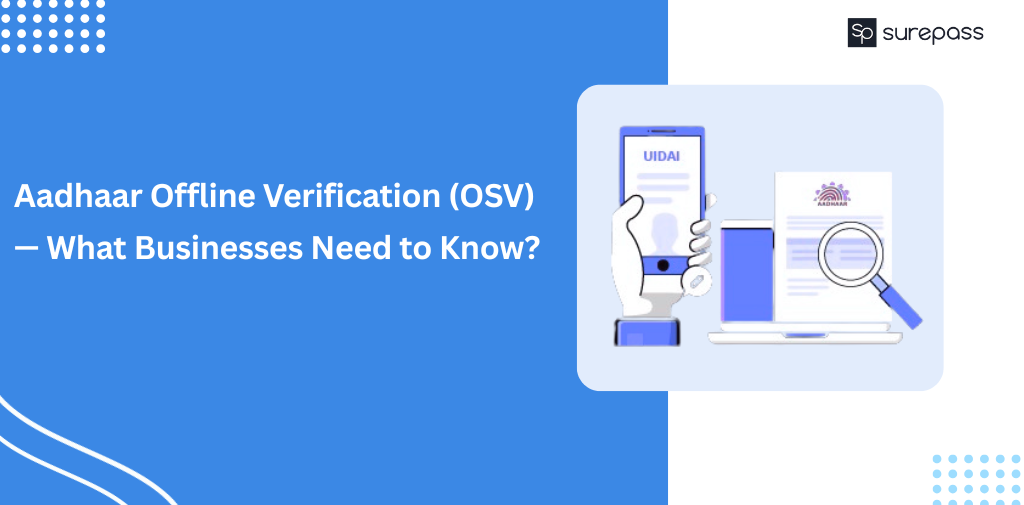
Identity verification is a crucial step for businesses before offering any service to the customer. The traditional paper-based verification is time-consuming, prone to manual errors, and document fraud. The online verification requires accessing the CIDR database and OTP authentication. However, it often fails in remote locations due to OTP delays or poor internet connectivity. The offline Aadhaar verification solves this issue with paperless and secure verification.
What is Aadhaar Offline Verification?
It is a method of verifying an Aadhaar identity without requesting authentication from the CIDR database. Instead, businesses can verify identities using a QR code and an XML file. It is a paperless e-KYC solution for organizations.
Automate your KYC Process & Reduce Fraud!
We have helped 3000+ companies in reducing Fraud by 95%
Types of Offline Aadhaar Verification
These are the offline verification methods the organization uses:
Aadhaar Secure QR Code
It is a digitally signed visual code printed on Aadhaar letters, e-Aadhaar, and mAadhaar. On scanning this QR, Aadhaar information is displayed. It is tamper proof UIDAI signed a convenient method of verification that helps businesses verify identity. It is an ideal solution for businesses with a lack of internet connectivity.
Data Elements Shared via the Secure QR
- Reference ID
- Name
- Gender
- Date of Birth
- Mobile (if enabled)
- Email (if enabled)
- Address
- Photograph
- 2048-bit digital signature to confirm authenticity
Aadhaar XML (Offline XML)
The Aadhaar Paperless Offline e-KYC XML is a file. An Aadhaar holder can download with consent and share with businesses. It is a secure, encrypted, and digitally signed file containing demographic information, name, DOB, photo, and hashed mobile/email. So, a business can verify the identity of an individual without sharing full details.
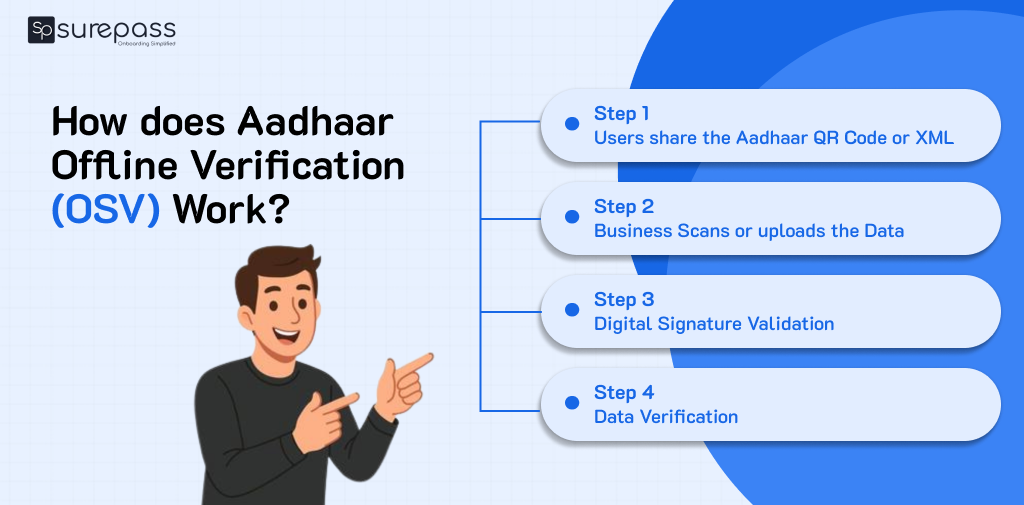
How Aadhaar Offline Verification (OSV) Works: Step-by-Step Guide
Here is how offline verification of Aadhaar works:
- Step 1: Users share the Aadhaar QR Code or XML
The individual provides the offline Aadhaar verification data in the form of a Secure QR code or a password-protected XML file.
- Step 2: Business Scans or uploads the Data
Business scans the Aadhaar Secure QR code or uploads the XML file to the system for decryption and verification.
- Step 3: Digital Signature Validation
The system verifies the digital signature issued by UIDAI to confirm that the Aadhaar data is genuine, untampered, and officially issued.
- Step 4: Data Verification
After successful signature validation, the demographic details are matched with the information submitted by the user for identity confirmation.
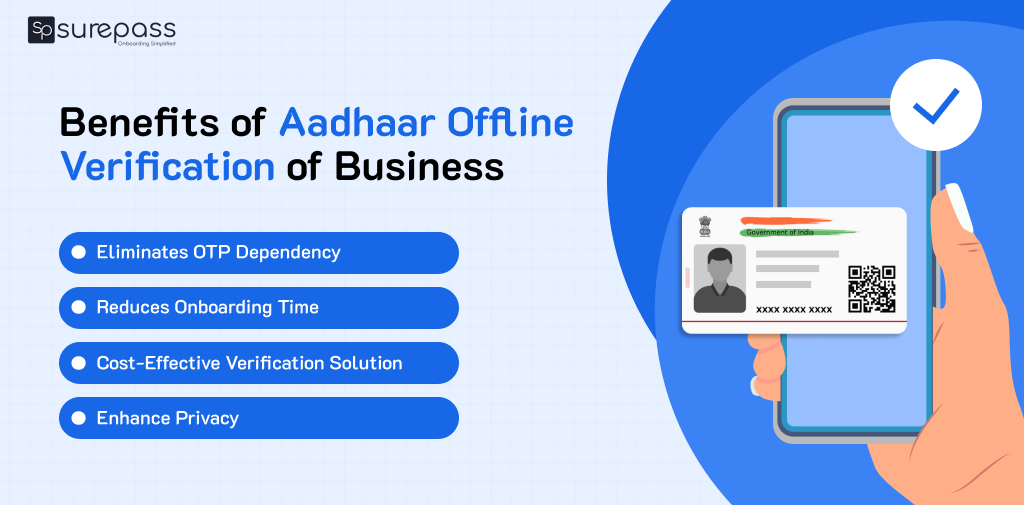
Benefits of Aadhaar Offline Verification of Business
These are the benefits a business gets:
- Eliminates OTP Dependency: Aadhaar OSV works without OTP or biometric verification. This reduces OTP verification failures that occur due to OTP delays or SIM-related issues.
- Reduces Onboarding Time: Offline verification through Aadhaar QR or XML helps in instant data validation. Customers can verify in seconds. It helps businesses onboard users more quickly and improve conversions.
- Cost-Effective Verification Solution: Entities conducting online verification need to develop their own infrastructure for secure verification. Developing town infrastructure requires high spending. On the other hand, for the offline verification, businesses don’t need such infrastructure.
- Enhance Privacy: In offline verification, only the selective data is shared with the verification organization. This reduces the exposure of sensitive personal information and its misuse.
Key Businesses Use Cases of Aadhaar Offline Verification
Fintech and NBFC
The offline Aadhaar verification helps banks and fintechs in verifying customer identity quickly without OTP or biometric authentication. It helps reduce onboarding time, prevents identity fraud, and ensures compliance.
Banking and Payments
Banks and payment service providers use Aadhaar OSV for identity verification during account opening, wallet verification, and customer re-verification.
Hospitality and Hospitals
Hospitality and healthcare Industries can use the Aadhaar offline verification for guest check-in and identity verification. QR verification replaces physical photocopies. It reduces manual checks.
Logistics and Delivery Verification
Logistics and delivery companies use Aadhaar OKYC to verify delivery partners, drivers, and recipients. It helps prevent fake identities, ensures secure onboarding, and supports large-scale verification without storing Aadhaar numbers.
Surepass Reliable Technical Service Provider for Offline Aadhaar Verification
Surepass is the reputed name in verification due to its advanced solution.
- End-to-end support for secure QR code verification and offline XML verification.
- Ready to integrate APIs and SDKs that reduce development time and cost.
- High accuracy with digital signatures verification and tamper detection.
- Ensure faster onboarding, minimal downtime, and reliable performance
- Offers dedicated technical support and documentation for smooth integration.
Conclusion
Aadhaar offline verification is an effective solution for businesses to conduct identity verification with security and accuracy. It replaces the need for OTP verification, speeds up the onboarding process, and reduces operational costs. With secure QR codes and encrypted XML files, businesses can easily verify the identities of customers. It makes onboarding simple and efficient.
FAQs
Ques: What is the process of offline verification of the Aadhaar Card?
Ans: The offline Aadhaar verification helps in verifying the Aadhaar identities without requesting CIDR.
Ques: What is the meaning of offline verification?
Ans: Offline verification means confirming a person’s identity through digitally signed data or documents without connecting to a central database.
Ques: Is customer consent required for Aadhaar Offline Verification?
Ans: Yes, consent is required for Aadhaar offline verification.
Ques: Who can use Aadhaar Offline Verification?
Ans: Any authorized organization that needs identity verification, including banks, fintech, hospitals, logistics companies, hotels, etc.
Ques: What data can be accessed through Aadhaar OSV?
Ans: Business can access limited demographic details such as name, DOB, gender, photograph, and address.
Automate your KYC Process & Reduce Fraud!
We have helped 3000+ companies in reducing Fraud by 95%