




Aadhaar offline verification allows businesses to verify the Aadhaar details via QR code or Aadhaar XML without connecting to CIDR. It replaces the need to collect and store physical copies of Aadhaar, as entities can verify an individual using the New Aadhaar app or a QR code scanner.
For conducting offline Aadhaar verification, a business needs to register with UIDAI as an OVSE. After that, they can conduct offline verification. However, to apply for OVSE, you must know the technical requirements to become an OVSE. Here, in this blog, you will learn about the technical requirements that an offline verification-seeking entity must know.
What is OVSE?
OVSE (Offline Verification Seeking Entity) is a registration framework that allows organizations to verify an Aadhaar holder without connecting to the UIDAI Central Identity Data Repository. It allows secure, consent-based, and privacy-friendly identity in offline mode. Any organization that wants to conduct secure offline Aadhaar verification needs to become OVSE. It requires registration.
Automate your KYC Process & Reduce Fraud!
We have helped 3000+ companies in reducing Fraud by 95%
What are the Technical Requirements to Become an OVSE?
These are the technical requirements an entity must have to become an OVSE:
- Logo in SVG format (less than 10kb)
- A callback URL where UIDAI will post the response data
- Organization name to display on Aadhaar App
- Domain name verification
- Public Certificate with a minimum of 2 years’ validity at least
- Application ID – Android/iOS (App to App intent call)
What to do after fulfilling the Technical Requirements?
If you have all the necessary technical requirements, you can proceed to registration:
- Download the OVSE application form from the UIDAI OVSE Registration Portal
- Fill in the required entity details, name, GST, address, contact details, etc.
- Attach Technical Documents (SVG logo, callback URL, Public Certificate, etc.)
- Get an authorized signature
- Submit the application to UIDAI
- Wait for review and approval from UIDAI
Why Do OVSE Applications Get Rejected? Common Mistake
Many organizations face rejection and delays in approval due to errors such as:
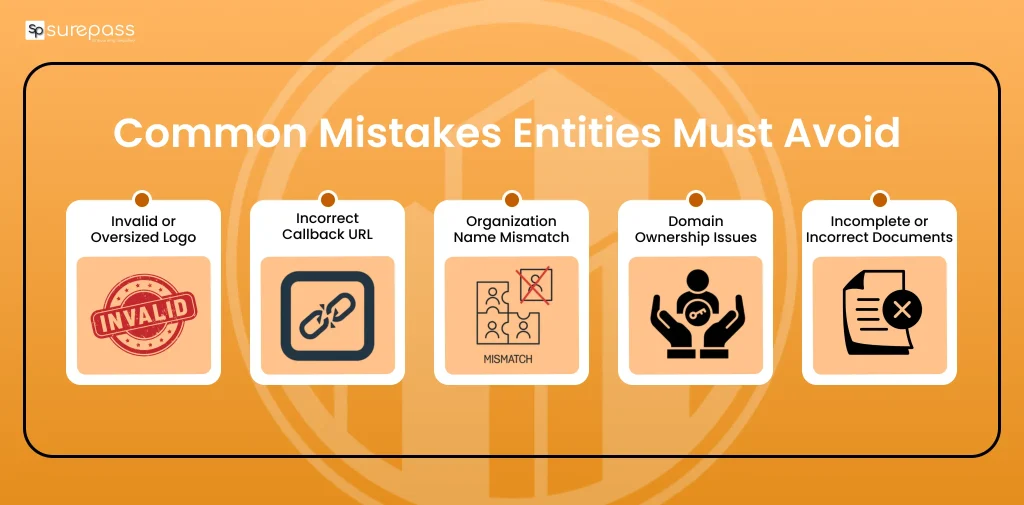
- Submitting an Invalid or Oversized logo: Do not submit the logo in random formats. It must be in SVG format and under 10KB. Ensure the logo is high-quality and clearly represents your brand.
- Incorrect Callback URL Configuration: Do not use non-HTTPS (insecure) URLs. The endpoint must be secure, active, and reachable. It will provide inactive or unreachable endpoints. Make sure to test the URL before submission.
- Mismatch in Organization Name: Any spelling error can lead to verification delays. Different name in legal records and application forms. Using brand names instead of registered entity names.
- Domain Ownership Issues: UIDAI conducts domain verification to check the ownership. Any errors in the domain can lead to rejection. This can occur due to expired or inactive domains.
How to Get Help If Your OVSE Registration Is Rejected?
If your OVSE application gets rejected or you need clarification or technical support. You can contact UIDAI through [email protected]. The UIDAI support team will review your application and help you resolve all the issues. So, you can complete the registration process.
What Benefits Do Organizations Get by Becoming an OVSE?
Becoming an OVSE offers multiple benefits to an organization:
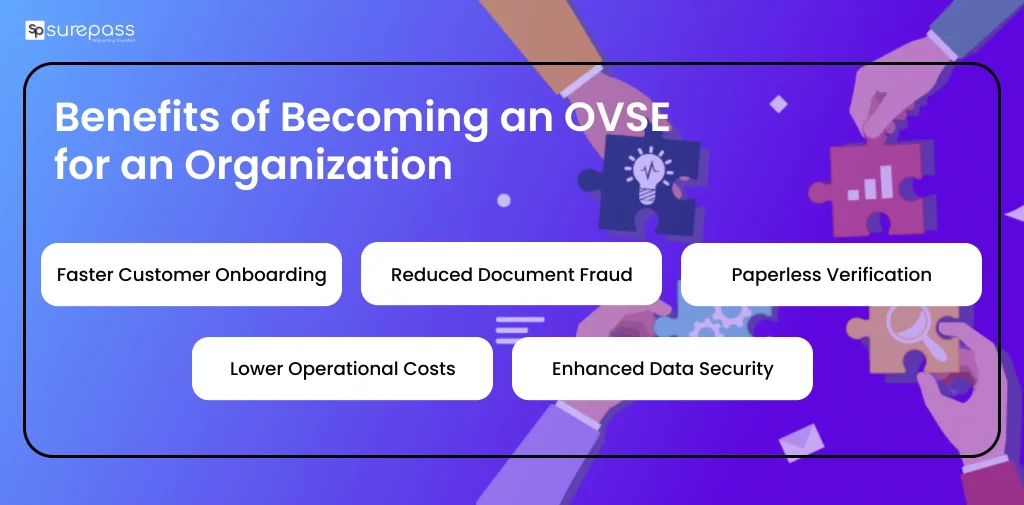
- Faster Customer Onboarding: After getting registered with UIDAI as an OVSE. An organization can conduct offline Aadhaar verification in minutes without any documentation or OTP verification.
- Reduced Document Fraud: QR verification and offline XML-based verification prevent the use of fake, edited, or forged Aadhaar documents.
- Paperless Verification: Digital verification eliminates the need for collecting and storing physical copies.
- Lower Operation Costs: It replaces manual checks, reduces paperwork, and storage of physical documents, and lowers operational costs.
Conclusion
Becoming an OVSE allows businesses to verify identities securely with QR scanning and Aadhaar XML-based verification. However, to conduct offline verification business need to complete registration with the UIDAI. Registration requires the technical requirements mentioned in the blog. Remember not to make any spelling or grammatical mistakes while submitting the OVSE registration form.
FAQs
Ques: Is OVSE registration mandatory for offline verification?
Ans: Yes, completing OVSE registration is mandatory for an organization that wants to conduct offline verification.
Ques: Can Startups apply for OVSE registration?
Ans: Yes, Startups having a legitimate use case for Aadhaar verification can apply for OVSE registration.
Ques: What is the full form of OVSE?
Ans: The full form of OVSE is Offline Verification Seeking Entity.
Ques: Is the internet connectivity required for offline verification?
Ans: No, you don’t need internet connectivity to conduct offline verification.
Ques: What are the technical requirements to become OVSE?
Ans: Entities require an SVG logo, callback URL, verified domain, valid certificate, and application ID, etc.
Ques: What is OVSE?
Ans: OVSE is a UIDAI-registered entity that has permission to conduct Aadhaar offline verification.
Ques: How can an entity become a registered OVSE?
Ans: An entity can become an OVSE by applying for OVSE registration.
Automate your KYC Process & Reduce Fraud!
We have helped 3000+ companies in reducing Fraud by 95%