




If you are a business that wants to conduct an offline Aadhaar verification through QR or Aadhaar XML, you need to apply for OVSE registration. Offline Verification-Seeking Entities can verify Aadhaar without real-time verification via the Aadhaar UIDAI database. Offline Aadhaar verification is fast, ensures privacy, and helps reduce fraud.
As per UIDAI’s Offline Verification Framework and Aadhaar regulations, only authorized entities with secure IT systems and defined verification purposes are permitted to conduct offline Aadhaar verification. Compliance with technical and legal standards is mandatory for approval.
Who can apply for OVSE Registration?
Any entity or business that has a valid use case for offline Aadhaar verification can apply for OVSE Registration. Here is the list of eligible entities:
- Healthcare service providers
- Hospitality and tourism sectors
- Gig Economy Platforms
- Entertainment and public event organizers
- Real estate and housing service providers
- Educational institutions
- Recruitment agencies
- Facility management companies
- Non‑governmental organizations (NGOs) and trusts
- FinTech and other technology companies
How to Apply for OVSE Registration?
Follow the steps below to apply for OVSE registration:
- Go to UIDAI OVSE Registration Page
- Click on Apply for OVSE Registration
- Download the Application Form for OVSE Registration
- Fill in the required entity and technical details
- Sign and stamp the application form by the authorized signatory
- Submit the application PDF to UIDAI via mail ([email protected])
- Wait for UIDAI review and approval.
- After approval, the applying entity will become a registered OVSE.
Automate your KYC Process & Reduce Fraud!
We have helped 3000+ companies in reducing Fraud by 95%
Technical Documentation Requirements
Entities need to submit technical documents to the UIDAI along with the form to become an OVSE. The following documents are required:
- Organization Logo: It must be in SVG format. It will be used in UIDAI applications to show your entity during offline verification workflows.
- Callback URL: UIDAI will send the verification response to this URL after successful offline Aadhaar verification.
- Public Certificate: Entity needs a public certificate with a minimum of 2 years’ validity. It helps in secure communication between UIDAI systems and the organization verification application.
- App/Software Details: Android/iOS App ID for mobile applications integrating offline verification. Domain name for verification.
Benefits of OVSE Registration
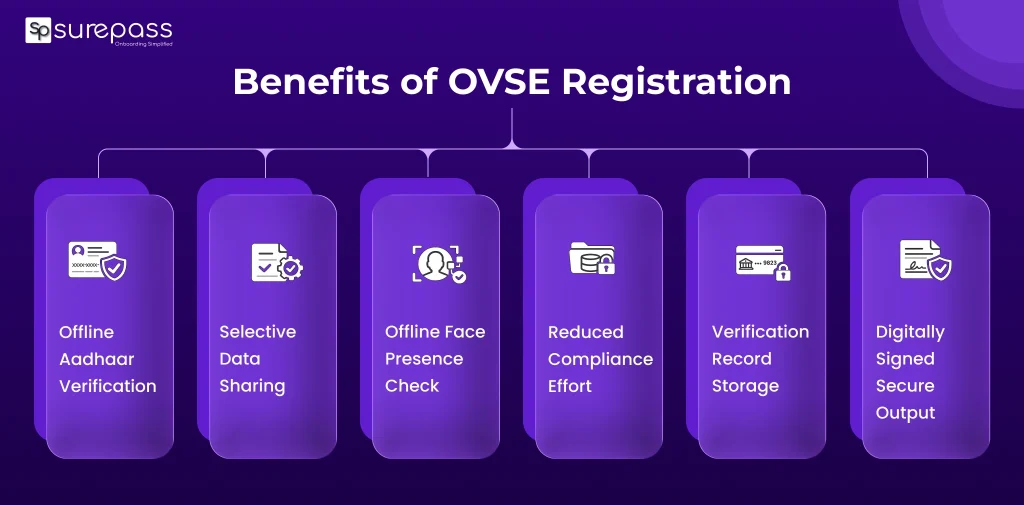
An organization gets multiple operational, security, and compliance advantages, such as:
- Offline and Secure Verification
OVSE registration allows businesses to verify Aadhaar details without real-time access to UIDAI’s central database. It ensures uninterrupted verification even in low connectivity areas.
- Option to Verify Aadhaar with Selective Data Sharing
Registered OVSEs can verify complete Aadhaar details or selective information such as name, DOB, or address. It ensures better privacy control and allows businesses to collect only the necessary data with user consent.
- Easy Integration with Business System
The OVSE Framework can be integrated with existing mobile apps, websites, and internal systems. This enables organizations to manage verification processes smoothly using Aadhaar Apps.
- Proof of Presence with Offline Face Verification
Registered OVSEs can use offline face verification to confirm the physical presence of an individual during identity verification. This prevents risk of identity theft, enhances security, and builds trust in sensitive verification processes.
- Lower Compliance Burden
OVSE Verification Framework simplifies regulatory requirements and reduces dependency on complex authentication systems. As a result, organizations can maintain compliance easily.
- Secure and Digitally Signed Output
The verification output is digitally signed and secure. It ensures that the information is authentic and tamper-proof for official use.
- Option to Store Verification Results
UIDAI-registered OVSEs are allowed to save verification results. It helps organizations maintain proper records, repeated verification, and enhance internal compliance management.
Compliance and Regulatory Framework
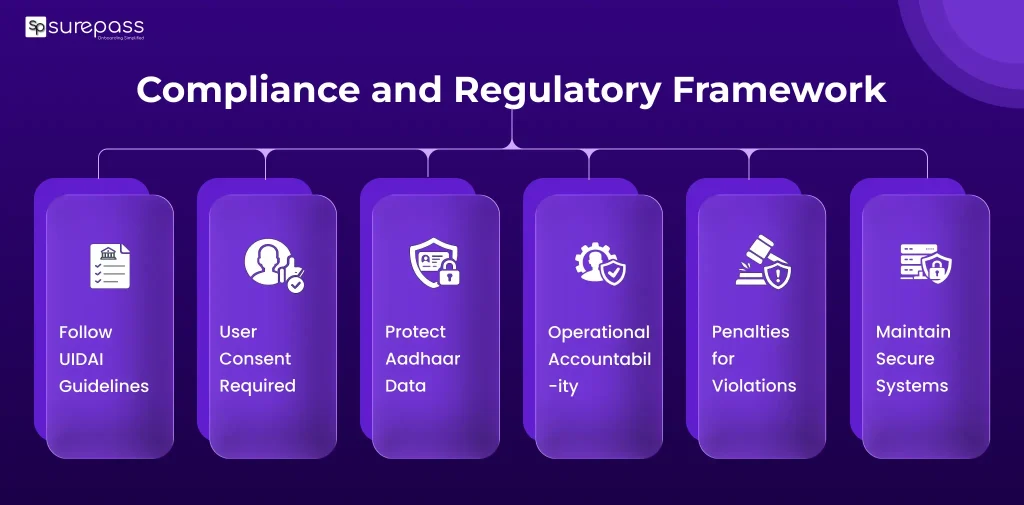
Registered OVSE should follow the UIDAI compliance and regulatory guidelines to maintain secure, lawful, and responsible use of Aadhaar offline verification.
- Legal Governance
OVSEs must follow the Aadhaar (Authentication and offline verification) guidelines and related rules.
- Data Privacy and Consent
Businesses can conduct Aadhaar verification after obtaining clear consent from the Aadhaar holder. Aadhaar information must not be misused, stored, or shared with unauthorized parties.
- Operational Responsibilities
Registered entities are responsible for maintaining secure systems and complying with the verification guidelines.
- Penalties for Non – Compliance
Any misuse, data breach, or violation of guidelines may lead to suspension, cancellation of registration, or legal action.
Conclusion
Offline Aadhaar verification helps businesses verify identities without interacting with the CIDR database, without any paperwork, and securely. It simplifies the Aadhaar verification process and removes errors that occur in paper-based verification, such as identity misuse, overexposure of data, and more.
Businesses can conduct offline verification after completing the registration with UIDAI. They need to have a lawful verification purpose to apply for registration. If you also want to become an OVSE, follow the above step-by-step guide and complete the registration process. Remember that Aadhaar is sensitive personal information, and any lack in compliance can lead to penalties and suspension of registration.
FAQs
Ques: What is Offline Aadhaar Verification?
Ans: It is a process of verifying individual identity by QR code and Aadhaar XML file without connecting to the CIDR UIDAI.
Ques: Can an OVSE verify Aadhaar without the holder’s consent?
Ans: No, offline verification can only be carried out with the consent of the individual.
Ques: How to Apply for OVSE Registration?
Ans: Follow these steps to apply for registration
- Go to the UIDAI website
- Click on Apply for OVSE Registration
- Download and fill out the form
- Submit the document
- Wait for review and approval
Ques: Who can become an OVSE?
Ans: Any legal business or entity with valid verification reasons can become an OVSE, including government departments, private companies, banks, NBFCs, Educational institution, etc.
Ques: What Is an Offline Verification-Seeking Entity?
Ans: An Offline Verification-Seeking Entity is an organisation authorised by UIDAI to verify Aadhaar via offline methods, such as QR scan, XML file, etc.
Automate your KYC Process & Reduce Fraud!
We have helped 3000+ companies in reducing Fraud by 95%