




Customers want faster onboarding and no waiting times. Paper-based manual checks are prone to errors and identity misuse. The online CIDR-based verification requires infrastructure and a high compliance burden. In simple words, conducting identity verification is complex for NBFCs.
NBFC can eliminate these issues with offline Aadhaar verification via the Aadhaar App, XML File, and QR Code. However, to conduct offline verification, an NBFC needs to obtain an OVSE certificate from the UIDAI.
What is Aadhaar offline verification for NBFC?
Aadhaar offline verification is a method that allows NBFCs to verify customer identity without physical in-person verification or online CIDR-based verification through
- Aadhaar App
- QR Code
- XML File
- e-Aadhaar
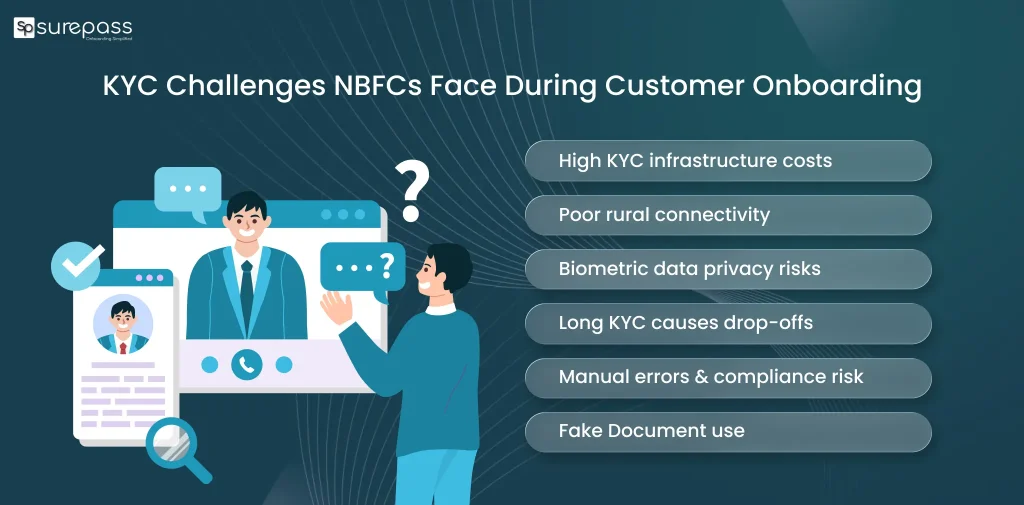
KYC Challenges an NBFC Faces during Customer Onboarding
Secure identity verification is mandatory for NBFCs. However, it faces many challenges, such as:
- High Infrastructure Costs: Conducting KYC requires infrastructure and security to keep Aadhaar details safe.
- Rural Connectivity and Accessibility: In rural and semi-urban areas, poor internet slows down the verification process.
- Data Privacy: Biometric information is sensitive personal data that increases security concerns.
- High Customer Drop-offs: Long verification process, in-person visits, and repeated document submission increase customer drop-offs.
- Manual Verification Errors: Manual data entry and physical document checks are prone to human errors; incorrect information can lead to verification failures and compliance issues.
- Fake Document Use: Many fraudsters use fake or forged Aadhaar documents to open accounts or gain illicit benefits.
Why NBFCs Should Use Aadhaar Offline Verification for Onboarding?
NBFC can overcome the above challenges through the Aadhaar offline verification:
- Reduces Infrastructure Costs: For online verification, NBFCs require high-security infrastructure to keep Aadhaar information safe. With the offline Aadhaar verification, NBFC can conduct verification through Verified Credential via Aadhaar App, QR, or XML file.
- Works in low Connectivity: With the new Aadhaar App, an Aadhaar OVSE for NBFC can conduct verification without high internet connectivity.
- Enhance Data Privacy: Customers can share selective data necessary for verification rather than full Aadhaar details. It enhances data privacy and reduces the risk of data misuse.
- Lower Customer Drop Off: The Aadhaar offline verification via the Aadhaar App eliminates the need for document submission and in-person visits. It makes onboarding faster and reduces customer drop-offs.
- Reduces Manual Verification errors: It eliminates the need for manual checks as well as errors in verification. Because QR and verified credentials are used instead of paper.
- Eliminates Use of Fake Documents: As digitally signed Aadhaar information is used, no fake or forged documents can be used.
Use Cases Aadhaar Offline Verification for NBFC
NBFCs can use offline Aadhaar verification in their workflow for:
- Digital Customer Onboarding: NBFCs can use offline Aadhaar verification for instant verification for new users. It will streamline verification processes.
- Loan and Credit Application Processing: The Aadhaar app-based verification process simplifies identity checks and reduces fake applications.
- e-KYC for App-Based Lending: NBFCs’ online platform using offline verification streamlines the remote verification process. It helps customers complete KYC from anywhere, without paperwork or an in-person visit.
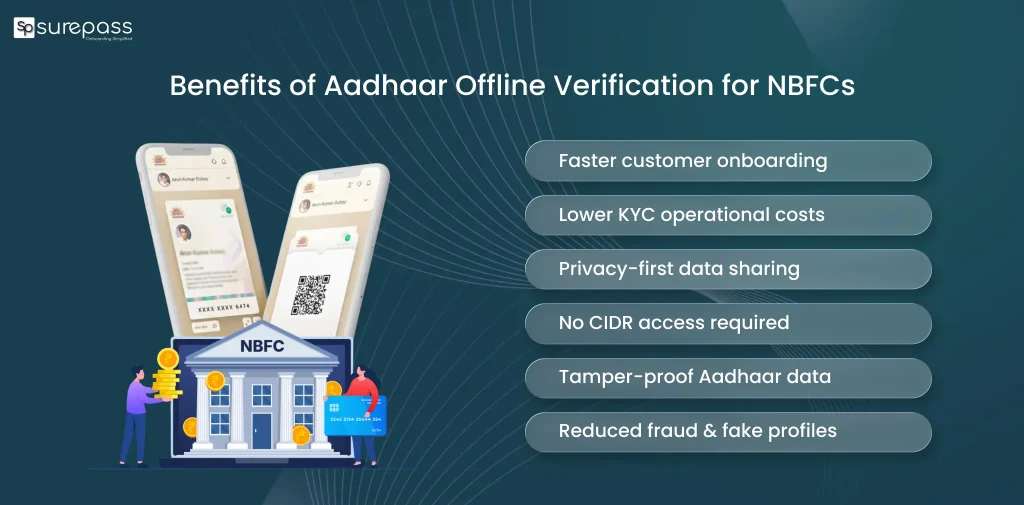
Benefits of Aadhaar Offline Verification for NBFCs
Offline verification offers various benefits to OVSEs:
- Faster Customer Onboarding
The Aadhaar offline verification makes onboarding quick by reducing manual checks and paper-based documentation. So, NBFCs can speed up loan and account approvals.
- Lower Operational Costs
For offline verification, businesses don’t require extensive infrastructure. So, it reduces the cost of online verification or manual verification.
- Stronger Data Privacy and Security
NBFC no longer needs to access the CIDR database. The customer only needs to share the necessary details required for verification.
- Reduced Fraud and Fake Profiles
The offline Aadhaar verification involves digitally signed information. This information is tamper-proof and ensures accuracy. It prevents forged documents and reduces the risk of identity theft.
Automate your KYC Process & Reduce Fraud!
We have helped 3000+ companies in reducing Fraud by 95%
What are the obligations for NBFCs Conducting Offline Verification?
Aadhaar offline verification is a secure and quick way of verifying Aadhaar identity. However, an NBFC should follow some privacy guidelines to avoid compliance issues:
- No Storage or Misuse of Aadhaar Data: OVSEs are not allowed to collect, store, or use Aadhaar numbers or biometric information. The offline Aadhaar details cannot be shared with any third party.
- Mandatory Reporting of Misuse: In case a data breach occurs, the NBFC must report it to UIDAI within 72 hours.
- Informing Affected Aadhaar Holders: In case of Aadhaar misuse or fraud, OVSE must inform the affected individuals. It must guide users on how to protect themselves from further risk of fraud.
- Responsibility for Third Party Compliance: If any part of the verification is outsourced. The OVSE will be responsible for the compliance. Third-party vendors must follow Aadhaar security and privacy rules.
Conclusion
The Aadhaar Offline Verification helps NBFCs onboard faster with privacy and security. An Aadhaar holder can share their details directly for the Aadhaar identity verification. Verification can be done offline without sharing full Aadhaar details. It reduces the risk of fraud and ensures secure onboarding.
FAQs
Ques: What is OVSE?
Ans: It is a UIDAI-authorized entity that helps verify Aadhaar identity without connecting to the CIDR database.
Ques: Is Aadhaar Authentication mandatory for loans?
Ans: No, it is not mandatory, but it is required for loans.
Ques: What Aadhaar offline methods can an NBFC (OVSE) use?
Ans: It can verify the Aadhaar identity through
- QR-Based verification
- Verified credential via Aadhaar App
- E Aadhaar
- XML-based verification
Ques: Does offline verification require user consent?
Ans: Yes, explicit consent is required before conducting verification.
Ques: Is OVSE registration mandatory for NBFCs to conduct Aadhaar offline verification?
Ans: Yes, NBFC or any other business that wants to conduct offline verification must complete OVSE registration.
Automate your KYC Process & Reduce Fraud!
We have helped 3000+ companies in reducing Fraud by 95%