


Before the offline Aadhaar verification method, businesses had only two ways to verify Aadhaar. One is connecting with the UIDAI CIDR database or verifying a physical copy of the Aadhaar. For CIDR-based verification, a business needs to obtain licenses and build infrastructure. On the other hand, physical verification requires in-person visits. It is prone to delays and document fraud. The Aadhaar offline verification resolves these issues with simple and secure alternatives, such as QR verification, XML file, eAadhaar, and through the Aadhaar App. Here, in this guide, you will learn about how Aadhar offline verification works without CIDR Access.
How Aadhaar Offline Verification Works Without CIDR Access?
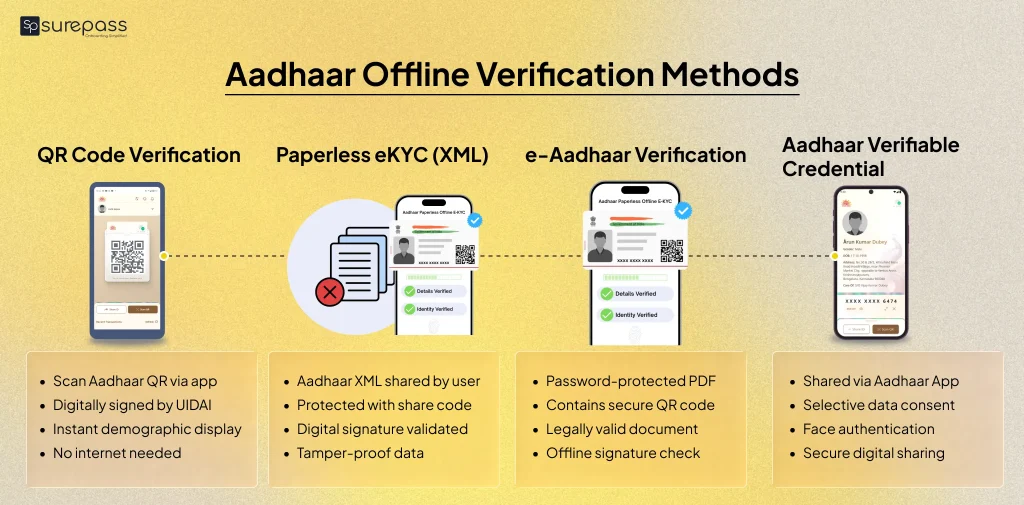
In Aadhaar offline verification, the Aadhaar details are verified using digitally signed data issued by UIDAI to the Aadhaar holder. In this process, the Aadhaar holder can provide Aadhaar information to the verifier. The verifier can verify the details through digital signature verification locally without accessing the CIDR database. There are mainly four types of Aadhaar offline verification methods.
Why does offline verification not need CIDR (Central Identities Data Repository) Access?
CIDR access is not needed in offline verification because the UIDAI provides digitally signed data to the Aadhaar holders. This information can be shared with the entity whenever required. Aadhaar holders can easily share their information without connecting to the Aadhaar database. The verification entity can verify the accuracy of information with digital signature verification. It is a secure process and prevents data misuse.
Types of Aadhaar Offline Verifications that work without CIDR Access
There are four types of Aadhaar Offline verification methods:
QR Code Verification
UIDAI provides a secure QR code on Aadhaar letters, PVC cards, and e-Aadhaar.
How does it work?
- Aadhaar holder will show the QR code to the organization.
- OVSE scans the QR code through the QR code scanner via the app.
- On successful verification, demographic details are displayed.
Automate your KYC Process & Reduce Fraud!
We have helped 3000+ companies in reducing Fraud by 95%
Aadhaar Paperless eKYC Verification
Aadhaar paperless eKYC is a digitally signed XML file that an Aadhaar holder can share for verification. It prevents misuse and eliminates paper-based verification.
How does it work?
- Aadhaar will download the Aadhaar XML file from the UIDAI portal or App.
- The user will share the XML code with OVSE.
- OVSE opens the XML through the share code.
- OVSE will verify the Digital Signature.
e-Aadhaar Verification
e-Aadhaar Verification is a secure, password-protected digital copy of the Aadhaar card. It is digitally signed and legally valid. It allows Aadhaar holders to store and share their details in digital forms. e-Aadhaar can also be used for offline verification.
How does it work?
- Aadhaar holders download the eAadhaar from UIDAI’s official website or app
- Share it with OVSE
- OVSE opens the e-Aadhaar PDF.
- OVSE verify digital signature.
- QR will be scanned with the application
- After successful verification, Aadhaar details will be verified locally
Aadhaar Verifiable Credential Verification
The new Aadhaar app provides verified, selective sharing of data with the verifiable credential. The credentials include Aadhaar demographic information.
How does it work?
- User downloads the Aadhaar App and logs in to the App.
- The organization sends a verification request.
- User reviews and approves the request.
- Face verification is done.
- Aadhaar details are shared securely.
- Verified information will be shared with the organization.
In all these methods, the verification will be done offline with information without accessing the CIDR database.
What is the difference between Online CIDR based verification and Offline Aadhaar verification?
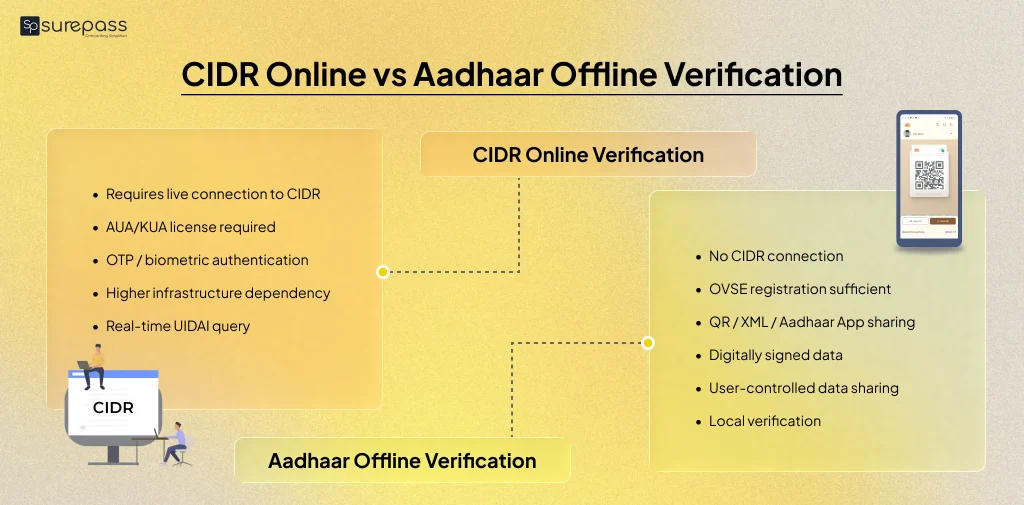
Both online and offline verification have many differences:
- Real Time Connection: For CIDR-based verification, the business requires secure internet connectivity. For offline Aadhaar Verification, you don’t need to have high internet connectivity.
- Verification Factors: In CIDR-based verification, biometric information or OTP verification is sent to the registered mobile number. In offline verification, users can share data directly to the Aadhaar App.
- License requirement: A business needs to obtain an AUA/KUA license to conduct CIDR-based verification. On the other hand, for offline verification, a business need to obtain an OVSE registration certificate.
- Data Security: The verification is done securely, and no sensitive personal information is stored. It gives high data security as the Aadhaar holder has control over what data they want to share.
- Use Case: CIDR-based verification is suitable for banks, NBFCs, and telecom services. Offline verification is suitable for hotel check-ins, SIM Card issuance, and in-person verification.
Conclusion
In Aadhaar offline verification, the digitally signed Aadhaar details are verified locally without accessing the CIDR database. The Aadhaar holder can share their information with the verifier through QR, XML File, or eAadhaar or Aadhaar App. The verifier can verify the information through digital verification or via the Aadhaar App locally without connecting to the CIDR database that is mentioned in the above guide.
FAQs
Ques: What is the penalty for unauthorized access to CIDR?
Ans: Unauthorized access to the CIDR database can lead to serious consequences, including 10 years of imprisonment and up to 1 Crore fine.
Ques: What is Aadhaar Offline Verification?
Ans: It is an offline verification process; individual identity is verified using QR code scanning, selective sharing of information, and Aadhaar XML file-based verification.
Ques: Is Aadhaar offline verification legally valid?
Ans: Yes, Aadhaar offline verification is a legally valid process. It allows organizations to conduct an identity verification process securely.
Ques: What is the difference between CIDR-based verification and Aadhaar offline verification?
Ans: CIDR-based verification is conducted in real time by connecting with the UIDAI database. On the other hand, offline Aadhaar verification digitally signed information is verified via QR codes, XML Files, or other secure offline methods.
Ques: Who issues a digitally signed document for offline verification?
Ans: Digitally signed Aadhaar data is issued by UIDAI, ensuring authenticity and security.
Automate your KYC Process & Reduce Fraud!
We have helped 3000+ companies in reducing Fraud by 95%