


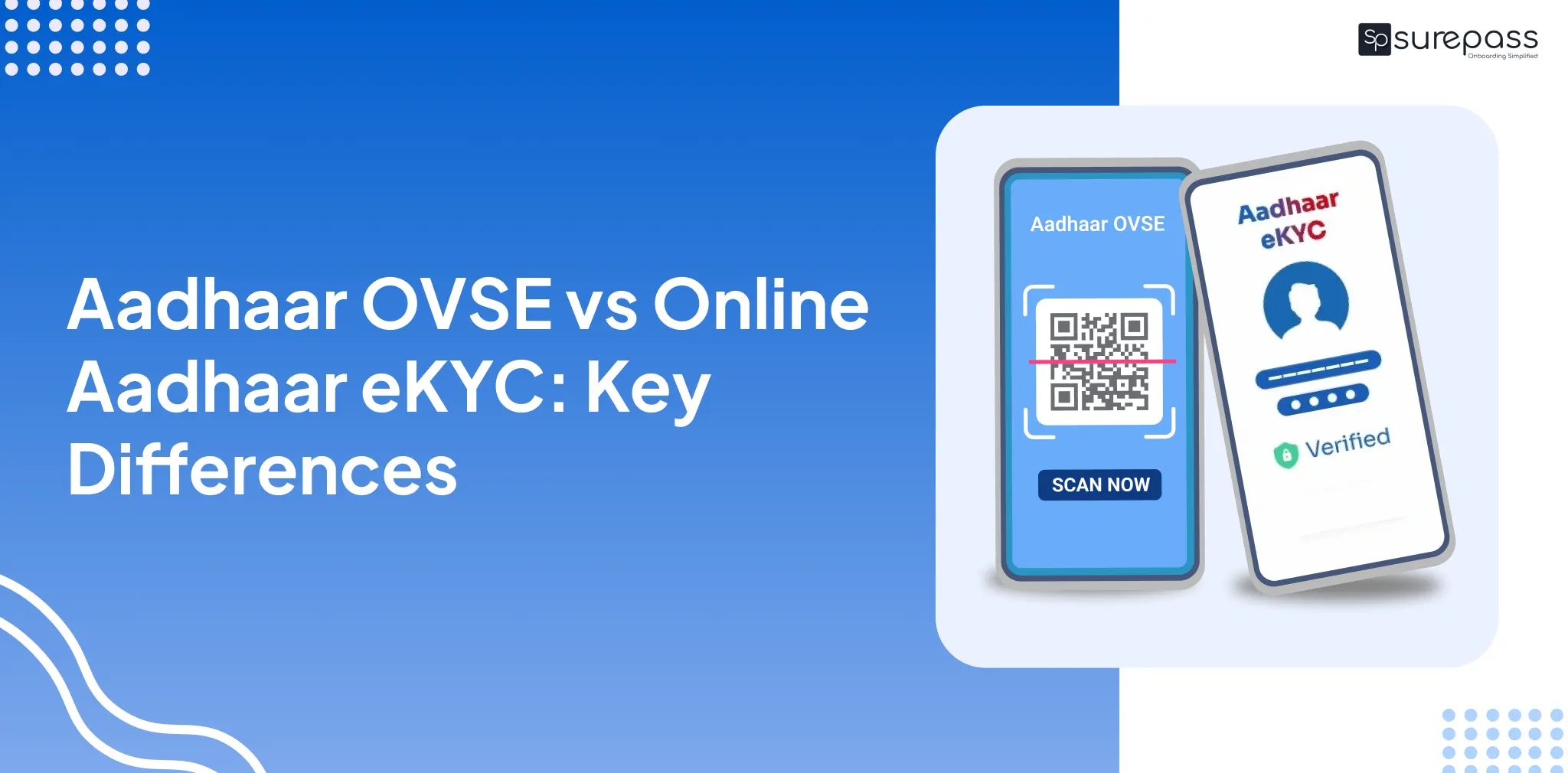
Most of the entities rely on Aadhaar for identity verification. This is a sensitive personal document that contains demographic and biometric information. Entities have two options to verify Aadhaar: Offline Aadhaar verification vs Aadhaar eKYC verification.
In this blog, you will know the difference between Aadhaar OVSE and online Aadhaar eKYC. It helps you understand the difference and which one you can choose?
What is Aadhaar OVSE?
An Aadhaar offline verification seeking entity (OVSE) is an authorized organization. It has permission to conduct offline Aadhaar verification without connecting to the UIDAI CIDR database. It can conduct consent-based processes using QR codes, e-Aadhaar, or XML files to verify information instantly without connecting to the CIDR database. An entity can become an Aadhaar OVSE after completing OVSE registration from UIDAI.
Automate your KYC Process & Reduce Fraud!
We have helped 3000+ companies in reducing Fraud by 95%
What is Online Aadhaar eKYC?
Online Aadhaar eKYC is a process of verifying Aadhaar details with the UIDAI CIDR database. Online Aadhaar eKYC includes two main methods: OTP based verification and biometric verification. Entities conducting this process need to connect with the UIDAI CIDR database.
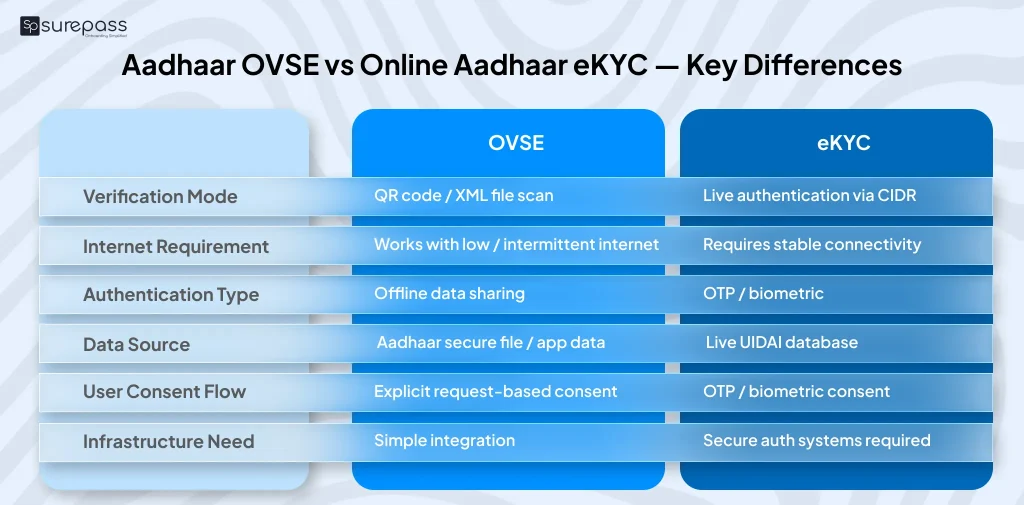
What are the key differences between Aadhaar OVSE vs Online Aadhaar eKYC?
Aadhaar offline verification is different from Aadhaar eKYC:
Mode of Verification
- Aadhaar OVSE: Entities verify the Aadhaar identity through the QR code and XML File.
- Online Aadhaar eKYC: In this process, the entity verifies the Aadhaar details online through CIDR authentication.
Internet Connectivity
- Aadhaar OVSE: It does not require continuous internet connectivity, as verification can be done online through QR and XML file.
- Online eKYC: Businesses need high connectivity for OTP verification and for receiving response information for verification.
Authentication Method
- Aadhaar OVSE: Verified credentials are shared with the verifier for verification.
- Online Aadhaar eKYC: It uses OTP or biometric verification and details received from UIDAI.
Data Source
- Aadhaar OVSE: Data is shared through the Aadhaar App.
- Online Aadhaar eKYC: Data is fetched live from the UIDAI CIDR database.
User Consent
- Aadhaar OVSE: All the OVSEs must obtain explicit consent of Aadhaar before verification in the form of a request.
- Online Aadhaar eKYC: In online Aadhaar eKYC, the organization obtains consent through the OTP and biometric verification.
Technical Infrastructure
- Aadhaar OVSE: Offline Aadhaar verification requires a simple setup and simple verification solutions.
- Online Aadhaar eKYC: For online Aadhaar verification, an organization needs secure authentication systems.
Use in Low Connectivity Areas
- Aadhaar OVSE: It is suitable for rural and low-network regions.
- Online Aadhaar eKYC: It is difficult for the entity verify Aadhaar online without high internet connectivity.
Risk of Data Exposure
- Aadhaar OVSE: In offline verification, only limited data is shared, and users have control over the information they share.
- Online Aadhaar Verification: It reduces the risk of live data transmission.
Compliance
- Aadhaar OVSE: The OVSE must comply with the Aadhaar Act 2016, the IT Act 2000, the DPDP, and other applicable compliance rules.
- Online Aadhaar eKYC: The organization conducting the authentication should follow the online compliance and audit rules.
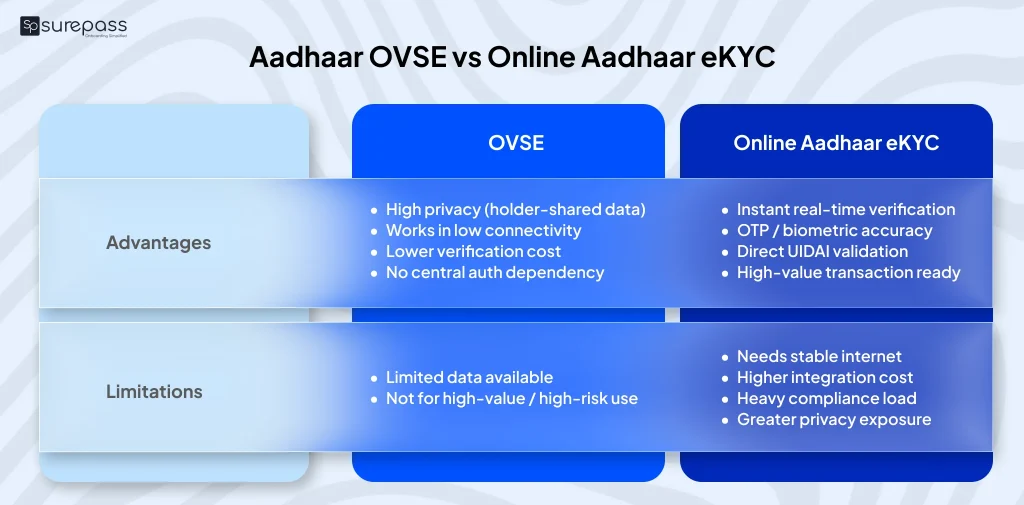
Advantages and Limitations of Aadhaar OVSE vs Online Aadhaar eKYC
Both Aadhaar OVSE vs Online Aadhaar eKYC have several advantages and limitations:
Advantages of OVSE
- It confirms high user privacy, as data is shared directly by the Aadhaar holder
- It can work with low connectivity connections
- Lower operational and verification costs
- It reduces dependency on centralized authentication systems
- It is suitable for rural and low-network areas
- Reduces exposure to sensitive personal information
Limitations
- Limited information will be shared as compared to online eKYC
- Not suitable for high-risk and high-value transactions
Advantages of Online Aadhaar eKYC
- It provides instant and real-time verification
- High accuracy through OTP and biometric authentication
- Direct verification from the UIDAI database
- Suitable for high-value accounts and transactions
- It reduces the chances of forged documents
Limitations
- It requires stable and high connectivity for conducting online verification
- Higher investment is required for authentication and APIs
- Increased compliance and audit burden
- Live data access increases the privacy concern
- It is not suitable for low-connectivity regions
- It requires cybersecurity infrastructures
Which one is better for your business, Aadhaar OVSE vs Online Aadhaar eKYC?
Choosing between offline verification and online verification depends on your business needs, customer base, risk profile, and compliance priorities. Aadhaar OVSE is better for businesses that want privacy, low connectivity, and onboarding.
On the other hand, businesses dealing with high risk customer or high value transaction should opt for online eKYC. It allows real-time authentication with biometric and OTP verification. It involves a higher cost and stricter compliance. It is a preferred choice for banks. Apart from this, organizations can use both of these methods according to use case.
Conclusion
Both Aadhaar online and offline verification are used to verify the identity of a person. It prevents fraud and associated risk. However, businesses get confused between the Aadhaar OVSE vs Online Aadhaar eKYC. The offline verification offers selective data sharing, no need for infrastructure, lower operational cost, proof of presence, and more. The Aadhaar online eKYC provides data from the CIDR database, need secure infrastructure and more. Offline verification is preferred for lower-risk transactions. In simple words, a business can choose the right method depending on the use cases.
FAQ
Ques: What is OVSE in Aadhaar?
Ans: OVSE is an offline verification seeking entity that has permission to conduct identity verification using QR code, XML file, and more.
Ques: What is the difference between Aadhaar OVSE vs Online Aadhaar eKYC?
Ans: OVSE is an offline way of Aadhaar verification without connecting to the CIDR database. In online eKYC, the entity verifies identity with real-time data access from the CIDR database.
Ques: What is online Aadhaar eKYC?
Ans: It is a process of verifying the Aadhaar by fetching details from the database.
Ques: Can businesses use both OVSE and Online eKYC together?
Ans: Yes, businesses can use both OVSE and online eKYC together.
Ques: Which is more suitable for rural and low-network areas?
Ans: Aadhaar offline verification is more suitable for rural and low-network areas.
Automate your KYC Process & Reduce Fraud!
We have helped 3000+ companies in reducing Fraud by 95%