
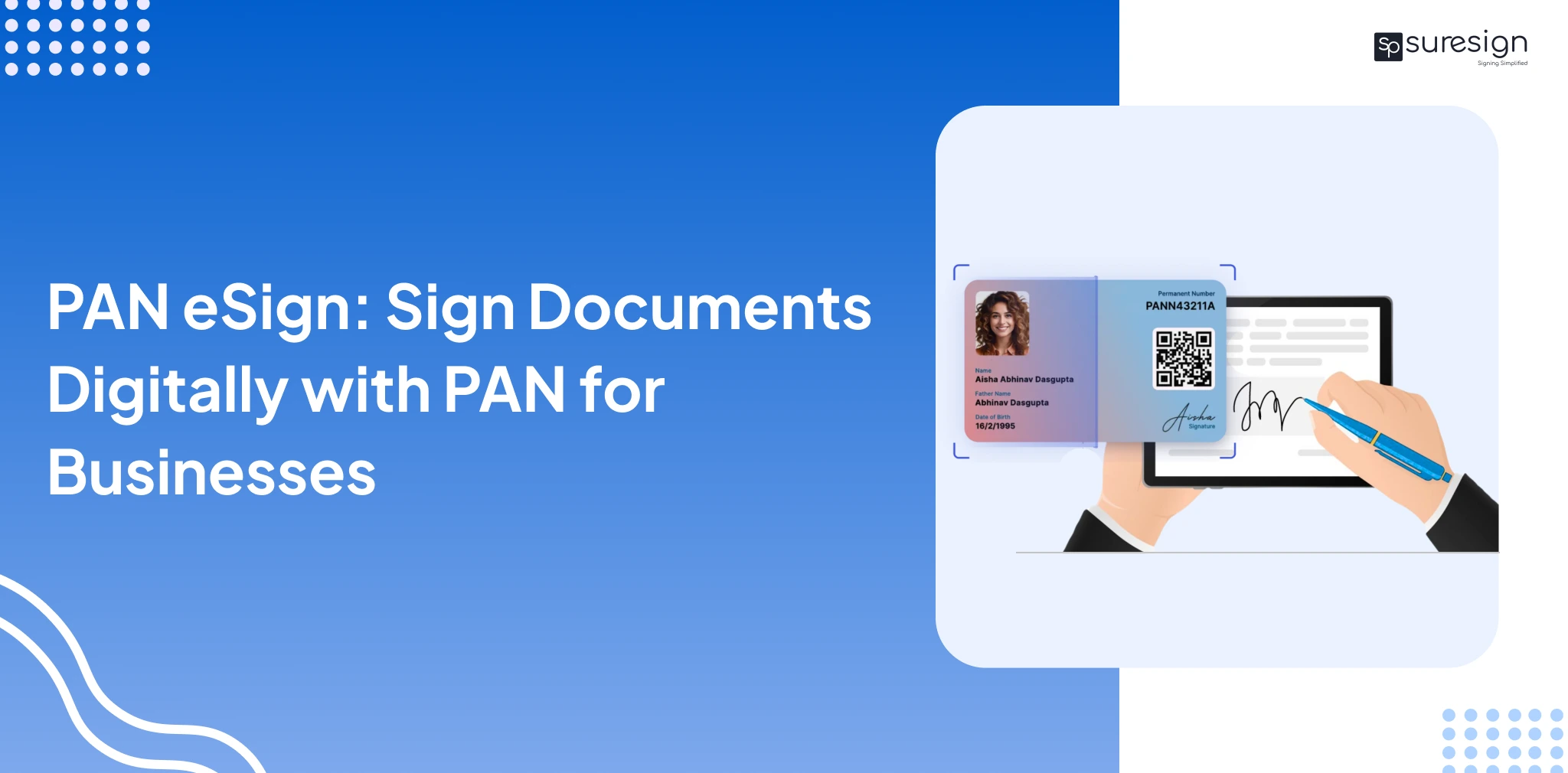
Printing, signing, scanning, and uploading the PAN document is time-consuming. It requires manual efforts, delays onboarding, and increases the risk of fraud. PAN esign eliminates the paper-based, time-consuming process. It streamlines the document signing process with security. Here in this blog, you will learn about PAN eSign, how it works, and its benefits.
What is PAN eSign?
It is an electronic signing method that allows individuals and businesses to eSign documents through Aadhaar-based authentication linked to the PAN. Instead of printing and physically signing papers. In this process, users can verify their identity through an OTP sent to their Aadhaar-linked mobile number and apply a legally valid electronic signature. It is used in KYC, banking, fintech, and compliance workflows.
How does PAN eSign work?
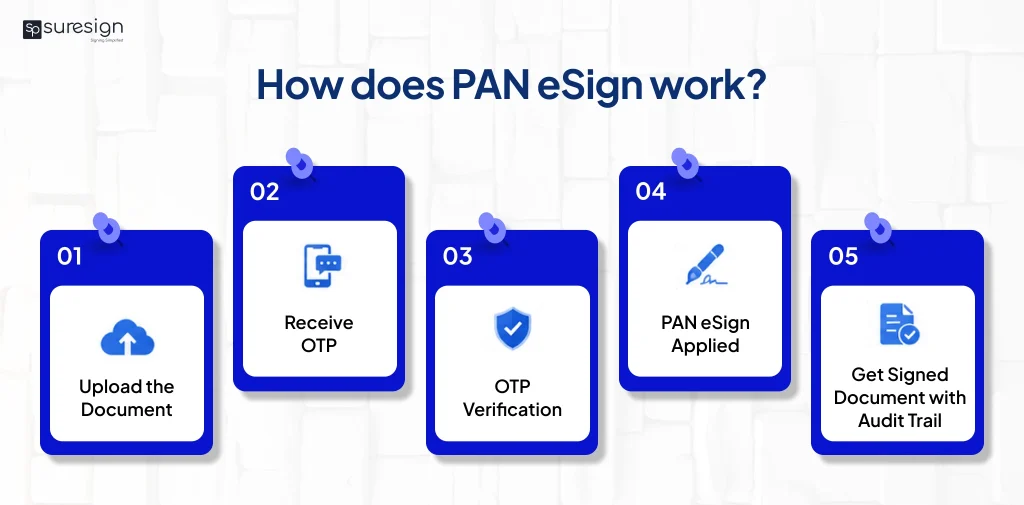
Here is a simple overview of its works:
- Upload the Document: The user or business uploads the document you want to sign (e.g., agreement, KYC Forms, or declarations).
- Receive OTP: An OTP (One Time Password) is sent to the registered mobile number for authentication.
- OTP Verification: User enters the OTP to verify their identity.
- PAN eSign Applied: After verification, the PAN eSign is applied to the documents.
- Get Signed Document with Audit Trail: The sign document will be generated along with the detailed audit trail.
- Time of Signing
- IP Address
- Authentication Method
Automate your KYC Process & reduce Fraud!
We have helped 3000+ companies in reducing Fraud by 95%
What are the Benefits of PAN eSign?
These are the benefits of using this eSign method:
- Efficient Method: eSign document is a quick process compared to the traditional manual signing process, which takes days. It hardly takes seconds.
- 100% Paperless Process: Go completely digital and remove dependency on physical documentation. No printing, no scanning, no courier, end-to-end electronic execution.
- Save Resources: It replaces manual paper-based documentation, storage, and logistics costs. It helps save resources and costs.
- Improve Security: It uses Aadhaar-based PAN verification that confirms that the signature is verified and legally compliant. It reduces the risk of identity theft and builds trust.
- Complete Audit Trail: It maintains full transparency with detailed logs of every transaction. Each signed document includes timestamps, authentication details, and traceable records.
Applications of PAN eSign
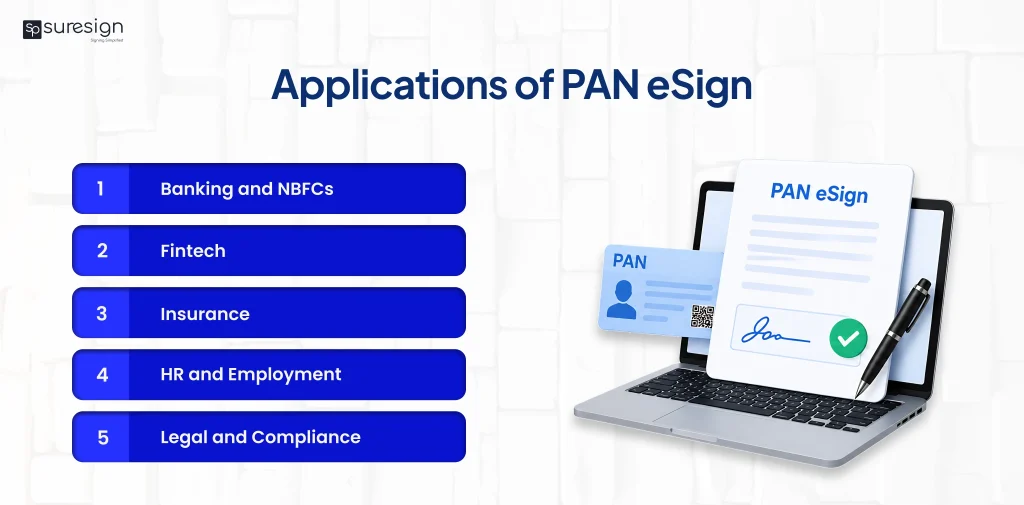
These are sectors that can use it to streamline the document e-signing process:
- Banking and NBFCs: Banks and NBFCs can use PAN eSign, which allows customers to sign loan papers and open accounts online. Customers no longer need to visit the branch or sign physical documents.
- Fintech: In the Fintech sector, it helps in the quick verification of customers and complete onboarding. The user can sign documents while signing up online easily.
- Insurance: Insurance companies can use this eSign to let customers sign policy documents digitally. It makes buying insurance faster and fully online.
- HR and Employment: Companies can use PAN e-Sign for sending offer letters and contracts to employees. Candidates can sign documents from anywhere without printing.
- Legal and Compliance: Businesses can rely on it to sign agreements and declarations securely. It helps maintain proper records and follow legal requirements easily.
Suresign PAN eSigning for Signing Documents
Suresign offers a PAN eSign solution that automates the document signing process. It replaces manual paper signing, saves time, and increases the efficiency of work. It replaces the traditional document signing process. The user just needs to upload the document, enter the PAN card number, verify with OTP, and eSign the document. It promotes remote signing; you can sign a document from anywhere, anytime.
Security and Compliance in PAN eSign
It is designed to confirm high levels of security and regulatory compliance:
- End-to-End Encryption: During the document e-signing process, all documents and data are encrypted during transmission and storage. It ensures that sensitive information remains protected from unauthorized access.
- OTP Based Authentication: Each signing request will be verified through a One-Time Password (OTP) sent to the user’s registered mobile number.
- Tamper-Proof Documents: After document signing, no one can access or alter it. If any changes are made after signing can be detected easily.
- Detailed Audit Logs: Every transaction is recorded with the complete audit trail, including timestamp, IP address, and authentication details.
Conclusion
The traditional manual signing process is time consuming and prone to tampering. The eSign solves this issue with the quick e-signing of a document. It makes the document signing process convenient and gives a remote access facility. Means a customer can sign a document anytime from anywhere. Suresign offers the PAN eSign that smoothly integrates with the business and streamlines the document signing process.
FAQs
Ques: Is PAN eSign legally valid in India?
Ans: Yes, it is legally valid in India.
Ques: Do I need both PAN and Aadhaar for PAN eSign?
Ans: Yes, PAN Aadhaar linking is required for OTP verification to sign the document.
Ques: Can a signed document be modified after PAN eSign?
Ans: No, once a document is signed, it can’t be modified. Any manipulation will invalidate the signature.
Ques: What is the difference between PAN eSign and Digital Signature Certificates (DSC)?
Ans: PAN eSign is a OTP based process, whereas DSC requires USB Tokens.
Ques: Can PAN eSign be used on mobile devices?
Ans: Yes, it smoothly works across web and mobile devices.
Automate your KYC Process & reduce Fraud!
We have helped 3000+ companies in reducing Fraud by 95%