
Choosing the right stamp paper is essential for businesses and individuals. Because any mistake in choosing the stamp paper can bring penalties and rejection of documents. If you want to avoid this, you should know about the Judicial vs Non-Judicial Stamp paper.
What Is Non-Judicial Stamp Paper in India?
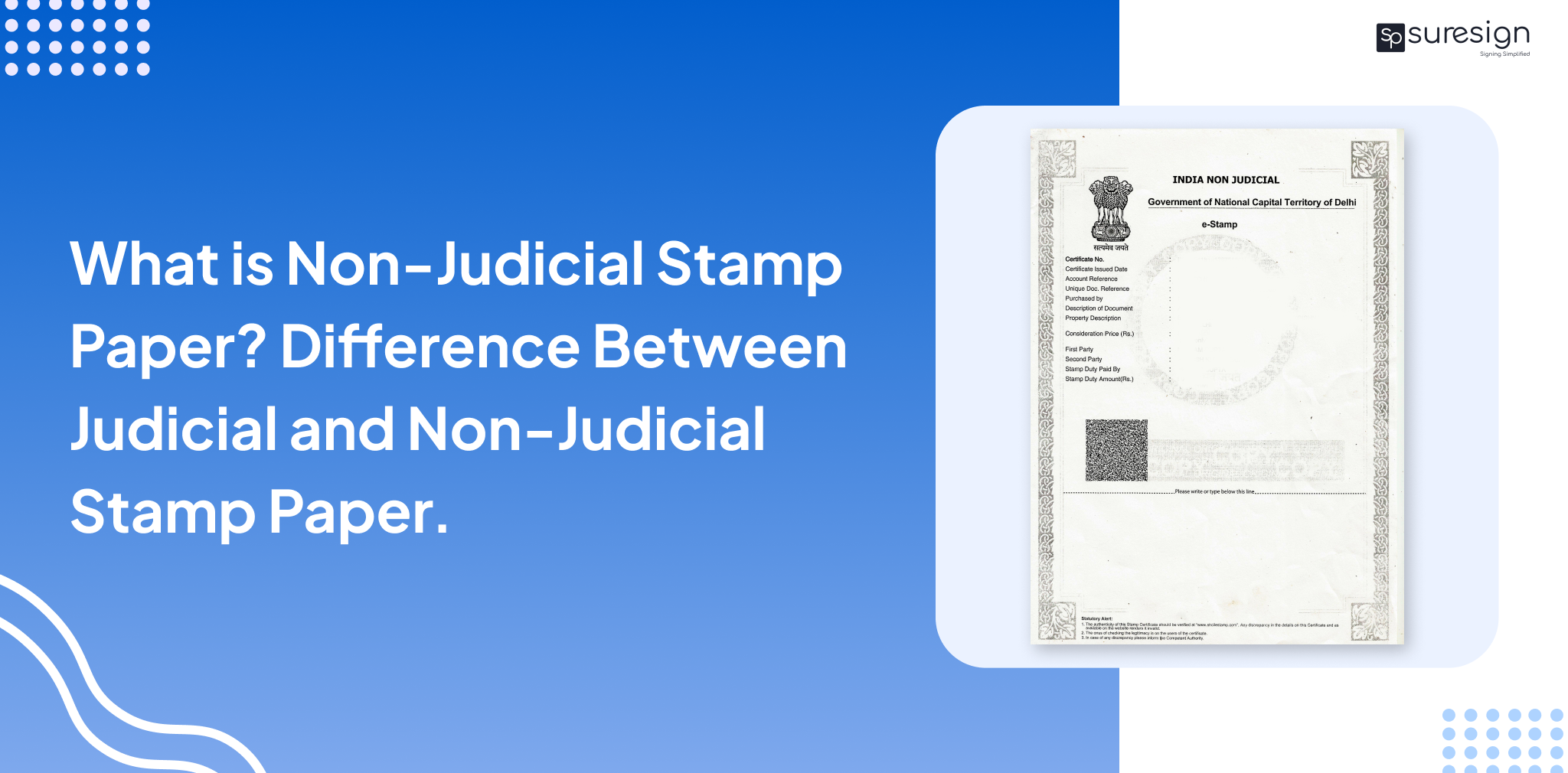
It is a stamp paper used for paying stamp duty to the government. It is used for agreements, affidavits, contracts, etc. It is a kind of legal proof that confirms stamp duty has been paid for a document. It prevents document forgery and acts as an official record of the agreement or declaration.
What is Judicial Stamp Paper?
Judicial Stamp Paper is a stamp paper used for court-related matters. It is primarily used for judicial proceedings and payment of court fees. It is issued under the Indian Stamp Act, 1899, for court filings and litigation purposes.
It confirms that court fees have been paid. It is required for filing petitions, suits, appeals, or complaints in civil or criminal courts.
What is the Difference Between Judicial v/s Non-Judicial Stamp Paper?
Both Judicial vs non judicial paper sound similar. However, they are used for different purposes.
Judicial vs Non-Judicial Stamp Paper
| Feature | Judicial Stamp Paper | Non-Judicial Stamp Paper |
| Purpose | Used for court cases and legal proceedings | Used for agreements, affidavits, and contracts |
| Usage | Filing petitions, apples, suits | Making legal and business documents |
| Applicable Law | Court Fees Act | India Stamp Act and State Laws |
| Who Uses It | Litigants and Lawyers | Individuals, business and companies |
| Validity | Only for court use | For legal and commercial use |
| Examples | Court fee and case filings | Rent agreement and affidavit bond |
| Notarization | Generally not required | Often required for affidavits and bonds |
| Denominations | Fixed as per court fee rules | ₹10, ₹20, ₹50, ₹100, ₹500, ₹1000+, etc. |
Where to get Non-Judicial Stamp Paper?
You can buy this stamp paper from the authorized vendor, cooperative banks, or through licensed stamp vendors at local courts. It can also be obtained online through the Stock Holding Corporation of India Limited (SHCIL) portal and from Suresign eStamping API.
Automate your KYC Process & reduce Fraud!
We have helped 3000+ companies in reducing Fraud by 95%
What are the types of non-judicial stamp paper?
There are mainly three types of non-judicial stamp paper:
- Physical (Paper)
It is a printed paper that you buy from licensed stamp paper vendors or government offices. The value of stamp paper, like Rupeses 10 or 20, is already printed on it. This paper contains a serial number and security watermark for forgery prevention.
- E-Stamp Paper
An e-stamp paper is a digitally secure document used to pay non-judicial stamp duty to the government. It has a unique identification number (UIN) and a QR code. It has the same legal validity as physical stamp paper. It is more secure than physical stamp paper.
- Adhesive Stamp Paper
Adhesive stamps are small stamps that look like postage stamps. These stamps are pasted on documents and then signed to make them valid. They are used for small transactions, receipts, or specific legal forms.
What is the use of Non-Judicial Stamp Paper in India?
It is widely utilized for the following functions:
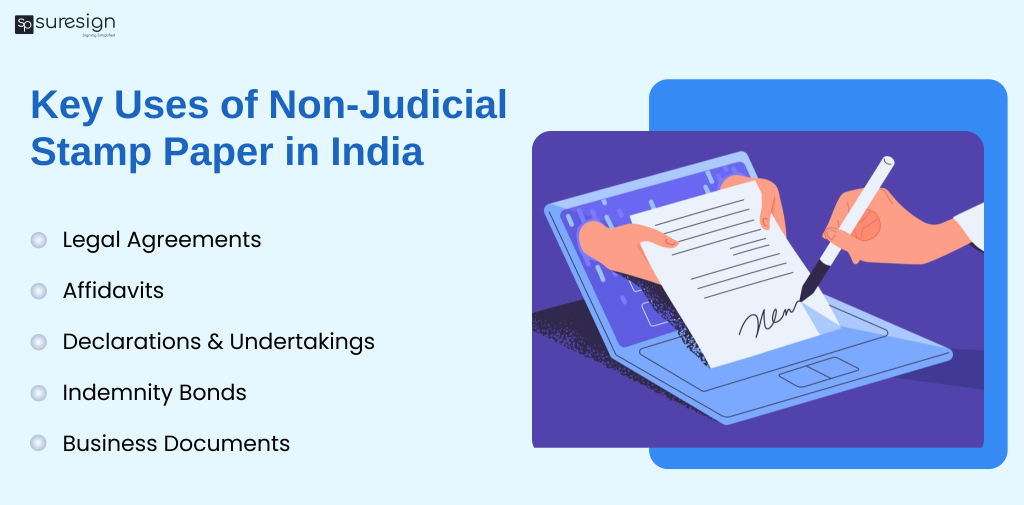
- Legal Agreements: It is used to prepare agreements such as Rental/Lease Agreement, Sale Agreement, Service Agreement, Partnership Deed, and Employment Contract.
- Affidavits: They are used for sworn statements, such as Address Proof Affidavit, Name Change Affidavit, Income Certificate Affidavit, and the date of declaration. Without stamp paper affidavit has no legal value.
- Creating Declaration and Undertaking: It is used for self-declaration forms, undertakings for banks, schools, and offices. It is also used for legal promises and commitments.
- Making Indemnity Bonds: It is used to prepare indemnity bonds for lost documents, bank guarantees, insurance claims, and company liabilities. It protects one party from financial loss.
- Business and Corporate Documents: The company often used it for vendor agreements, shareholder agreements, MSME contracts, Franchise agreements, and MoUs (Memorandum of Understandings). It helps in compliance and audits.

What is the use of Judicial Stamp Paper?
Judicial Stamp Paper is commonly used for:
- Court Fee Payments: It is mandatory to file civil suits, petitions, and legal cases to ensure they are admitted.
- Affidavits and Petitions: It is used for filing affidavits and formal petitions.
- Legal Proceedings: Judicial stamp paper is required for submitting documents in courts, such as ball application or witnesses
- High Value Filings: It is used for commercial cases that require specific and higher-value stamps.
Conclusion
Paying stamp duty and choosing the right stamp paper are essential. Judicial vs non-judicial stamp paper is different. So, a business must know the differences and choose the right one. The above guide helps you understand the difference between judicial stamp and Non-judicial stamp paper. So, you can choose the right stamp paper for preparing contracts and legal agreements.
FAQs
Ques: What is the meaning of non-judicial stamp paper in India?
Ans: It is stamp paper that helps pay stamp duty on legal documents such as affidavits, agreements, declarations, and property-related documents in India.
Ques: What is the validity of non-judicial stamp paper?
Ans: It has no expiry period.
Ques: What is the expiry of non-judicial stamp paper?
Ans: There is no expiry , and it can be used anytime.
Ques: Can an agreement on non-judicial stamp paper be legally enforceable?
Ans: Yes, agreements or non-judicial stamp paper are legally enforceable and valid in India.
Ques: Is non-judicial stamp paper valid in court?
Ans: Yes, it is valid in court if it is properly stamped, correctly filled, and duly signed.
Ques: Can a non-judicial stamp paper be purchased in the name of a lawyer?
Ans: No, it should be bought only in the name of the involved parties.
Ques: How to purchase non-judicial stamp paper?
Ans: You can purchase it online from the SHCIL website or offline through a licensed vendor or through the Surepass eStamp API.
Ques: What is the difference between judicial and non-judicial stamp duty?
Ans: Judicial stamp duty is paid for court cases and legal proceedings, while non-judicial stamp duty is paid for agreements, affidavits, and other private legal documents.
Ques: How to check non-judicial stamp paper?
Ans: You can check the legitimacy of the eStamp paper through the SHCIL website
- Visit the SHCIL website.
- Select Verify e-Stamp Certificates.
- Enter details.
Ques: What is the size of non-judicial stamp paper?
Ans: Usually, A4-size is used. However, the dimension is Legal Size (8.5”x14”).
Ques: What is the special adhesive vs non judicial stamp duty?
Ans: Special Adhesive stamp duty is paid using pasted small labels on documents, while non-judicial stamp duty is paid using full stamp paper or e-stamp.
Automate your KYC Process & reduce Fraud!
We have helped 3000+ companies in reducing Fraud by 95%